
How Long Does Ketamine Work for Depression?
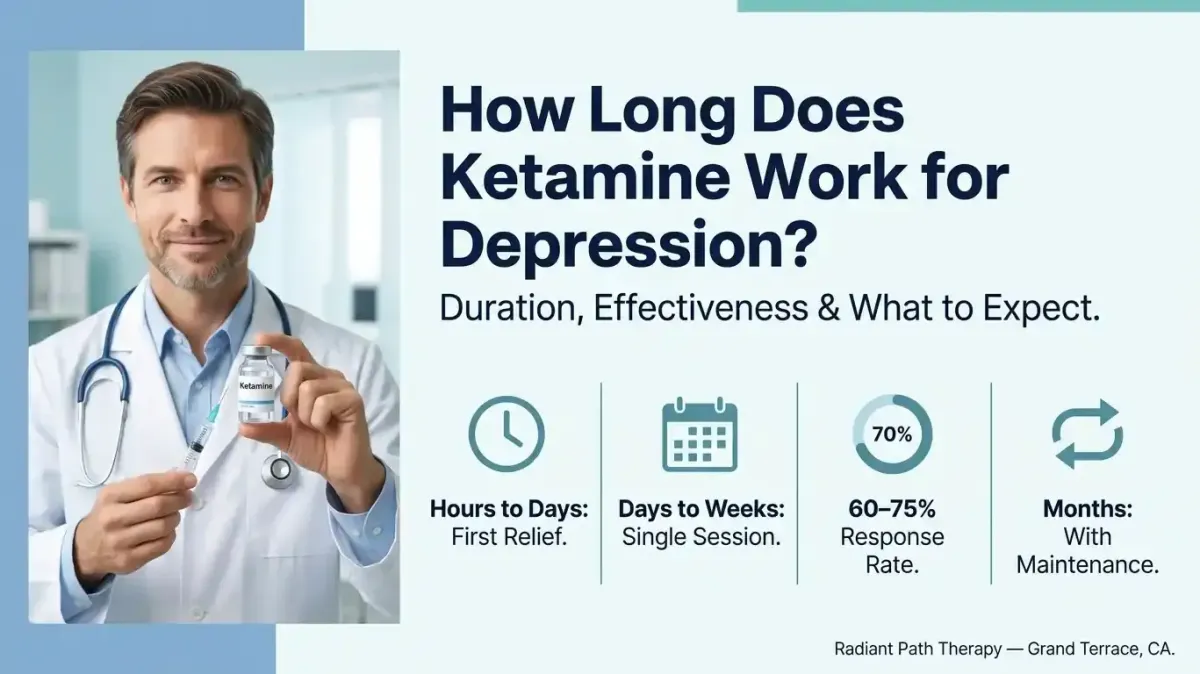
How long does ketamine work for depression? Ketamine can begin reducing depressive symptoms within hours for some people, with effects often strongest during the first day. After a single IV treatment, improvement may last several days to about one week. Repeated treatments can help maintain or extend the response, but the exact duration varies from person to person.
For people in Grand Terrace, CA, understanding this timeline can help set realistic expectations before treatment. At Radiant Path Therapy, factors such as the type of treatment, individual response, depression severity, other treatments, and ongoing care should all be considered when discussing how long ketamine may continue helping with depression.
It is also important to separate fast symptom relief from broader recovery. Mood symptoms may improve rapidly, while changes in work, relationships, sleep, and everyday functioning may develop on a different timeline. Research on functional outcomes is still limited, and newer real-world esketamine data suggest that functional recovery may occur more gradually than symptom improvement.
What Is Ketamine and How Does It Work for Depression?
Ketamine has been used as an anesthetic for decades. In mental health care, some clinicians also use ketamine off-label for depression, especially when standard treatments have not provided enough relief. Ketamine itself is not FDA-approved to treat depression, although a related medicine called esketamine is approved for certain forms of depression in adults.
Ketamine is different from traditional antidepressants because it works mainly through the brain's glutamate system. This different pathway is one reason researchers have studied ketamine as a faster-acting option for depression.
How Ketamine Affects Brain Signaling
Ketamine affects NMDA receptors, which are involved in glutamate signaling between brain cells. Researchers believe this process influences pathways involved in learning, mood, and the brain's ability to form and strengthen connections.
The full antidepressant mechanism is still being studied. It is more accurate to say ketamine may support changes in brain signaling and neuroplasticity than to claim it permanently "rewires" the brain.
Why Ketamine Works Differently From Traditional Antidepressants
Many traditional antidepressants require regular daily use and may take several weeks before their full benefit becomes clear. Ketamine can affect depressive symptoms much faster in people who respond to it.
Clinical research on IV ketamine has found improvement within hours after treatment. However, a fast response does not mean everyone feels better immediately, and not every person with depression responds to ketamine.
How Quickly Does Ketamine Start Working for Depression?
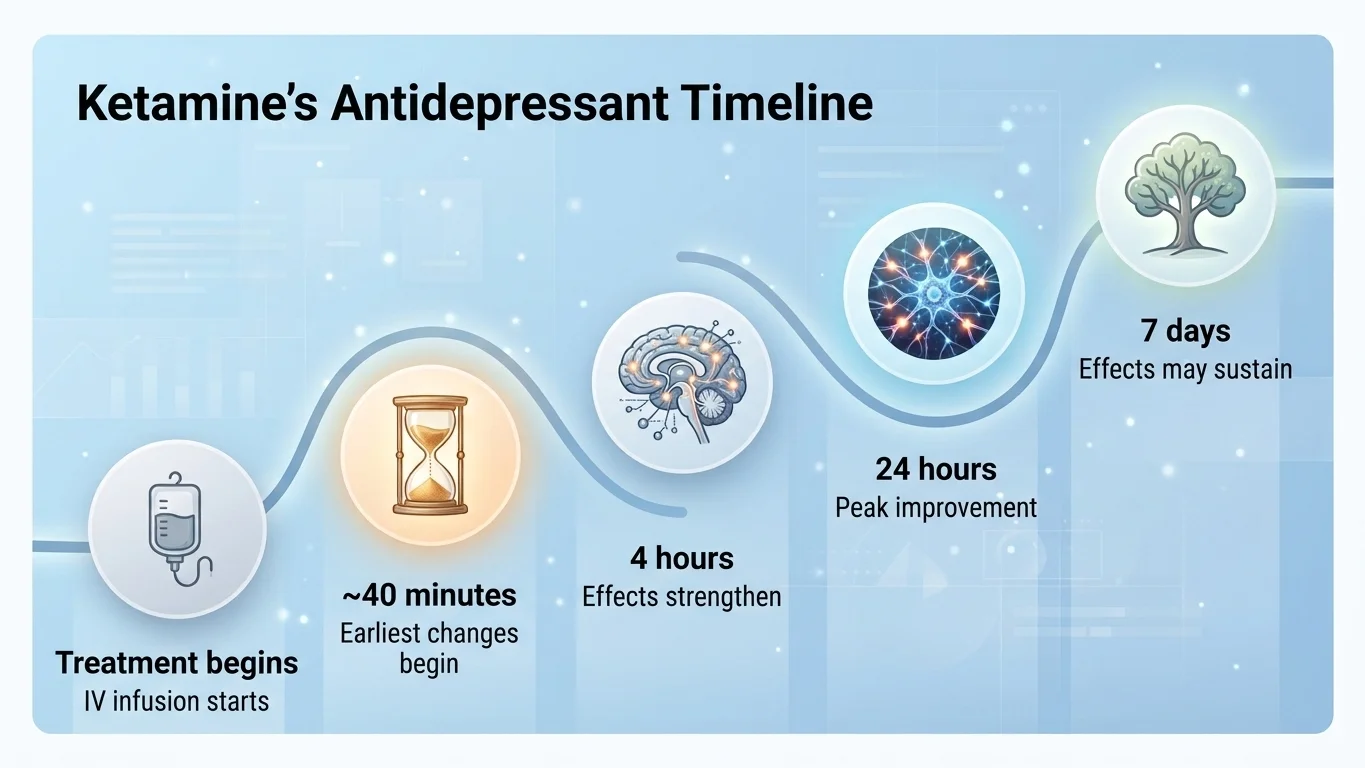
One of the main reasons ketamine has received attention is its rapid onset. Studies of IV ketamine have detected antidepressant effects within several hours, with some research finding changes as early as about 40 minutes after treatment. The strongest average improvement is often seen around the first day.
The exact experience is different for each patient. Some notice a meaningful change quickly, while others need repeated treatments before they can tell whether ketamine is helping.
First-Hour to First-Day Effects
During or shortly after an IV ketamine treatment, a person may experience temporary effects such as dizziness, changes in perception, or dissociation. These treatment-day effects are different from the antidepressant response and should not be confused with lasting mood improvement.
For people who respond, depressive symptoms may begin improving later the same day or by the following day. Research has found significant antidepressant effects around four hours and 24 hours after a single infusion.
Early Mood Improvements Patients May Notice
Early improvement does not always feel like suddenly becoming happy. A person may instead notice that hopelessness feels less intense, negative thoughts are easier to manage, or everyday activities require less effort.
Changes in motivation, concentration, sleep, relationships, and work performance may follow a different timeline. Mood improvement and full recovery in everyday functioning are not necessarily the same thing.
How Long Do the Antidepressant Effects of Ketamine Last?
There is no single duration that applies to every patient. The length of benefit depends on the type of treatment, individual response, number of treatments, and several clinical factors.
Research on a single IV ketamine infusion provides the clearest short-term timeline. Studies have found significant antidepressant effects from several hours through about seven days after one treatment. Longer-lasting effects are possible for some people, but they are less predictable.
Short-Term Relief After One Treatment
For people who respond to a single IV infusion, improvement may last for several days. Research reviews commonly describe antidepressant benefits lasting about three to seven days after one treatment. One meta-analysis found significant effects at four hours, 24 hours, and seven days after a single infusion.
Evidence was much less certain by 12 to 14 days. This is why one treatment should not automatically be viewed as a permanent solution for chronic or treatment-resistant depression.
What Happens After Repeated Treatments?
Repeated ketamine treatments may help sustain the initial antidepressant response during the treatment period. Research has found stronger or more sustained improvement with repeated administration compared with relying on a single dose.
However, there is no reliable rule that says a full series will provide exactly two weeks, one month, or several months of relief after treatment stops. Some patients may experience symptoms returning sooner, while others may maintain improvement for longer.
Why Duration Varies From Person to Person
Depression is not identical in every patient. The severity and duration of symptoms, previous treatment response, other mental or physical health conditions, current medications, and the specific ketamine treatment being used can all influence the treatment plan.
Individual response also matters. Two people can receive similar treatments and experience different levels and durations of improvement. This is why clinicians monitor symptoms over time instead of promising a fixed number of days or weeks.
What Factors Affect How Long Ketamine Works?
Several factors may influence how long a person continues to experience improvement after ketamine treatment.
Treatment method matters. Most of the stronger evidence about rapid duration comes from IV ketamine studies. Intranasal esketamine follows a different dosing and monitoring program.
The number of treatments matters. A single infusion usually provides a shorter treatment window than repeated administration in people who respond.
Individual treatment response matters. Some patients respond strongly after early treatments, while others experience partial improvement or no meaningful response.
Other mental health conditions may matter. Depression can occur alongside anxiety disorders, PTSD, substance use concerns, bipolar disorder, and other conditions. These may influence treatment decisions and overall recovery.
Ongoing mental health care may matter. Medication management, psychotherapy, healthy routines, and other evidence-based treatments may be included in a broader depression treatment plan. They should not be presented as guaranteed ways to make ketamine itself last longer.
Does Ketamine Require Maintenance Treatments?
Some people who respond to ketamine receive additional treatments because depressive symptoms can return after the initial benefit fades. However, there is no single FDA-approved maintenance schedule for IV ketamine used for depression because ketamine is used off-label for this purpose.
A clinician may decide whether further treatment is appropriate based on symptom response, side effects, medical history, and how long improvement lasts. Maintenance treatment should therefore be individualized rather than automatically scheduled every three, four, six, or eight weeks.
This is different from FDA-approved intranasal esketamine, which has a defined treatment schedule that changes after the induction phase.
How Many Ketamine Treatments Are Usually Needed?
Research on IV ketamine for treatment-resistant depression has often used a short series of repeated infusions rather than a single treatment. A frequently studied approach involves several infusions over roughly two to three weeks. Six treatments are commonly mentioned because several clinical studies have used a six-infusion course. However, this should not be presented as a mandatory or FDA-approved ketamine protocol for depression.
The number of treatments needed depends on response, tolerability, treatment goals, and clinical judgment. Some people may not respond even after several sessions, while others may notice meaningful improvement earlier. Longer-term treatment should be decided after reviewing whether the initial treatment produced enough benefit to justify continued exposure.
How Long Do the Effects of At-Home Ketamine Therapy Last?
There is no established standard timeline for how long the antidepressant effects of at-home ketamine last. At-home programs may involve compounded oral tablets, lozenges, or other formulations, and these products are different from the IV ketamine protocols used in much of the depression research. Compounded ketamine products are not FDA-approved for psychiatric disorders.
This means the FDA has not reviewed these compounded products for psychiatric safety, effectiveness, quality, or a standard treatment duration. Because the dose, route of administration, absorption, treatment schedule, and individual response can differ, it would be inaccurate to promise that at-home ketamine works for a certain number of hours, days, or weeks.
The FDA has also warned about risks when compounded ketamine is used without appropriate medical monitoring. These concerns include sedation, dissociation, and changes in vital signs. At-home ketamine should therefore not be described as simply a more convenient version of supervised IV treatment.
When Can Sleep, Work Focus, and Social Function Improve?
People searching for ketamine treatment often want more than a lower depression score. They want to know when they may sleep better, concentrate at work, reconnect socially, and handle normal daily responsibilities again.
There is currently not enough controlled evidence to give one reliable functional-improvement timeline for IV ketamine. A 2026 systematic review found no controlled ketamine studies that met its criteria for functional outcomes. That means claims such as "work focus improves within three days" or "social engagement returns after one week" would go beyond the current evidence.
More evidence is available for esketamine. Studies have reported improvements in areas such as workplace functioning and overall daily function during treatment. A recent real-world study found that functioning continued to improve across one, three, and six months, while functional recovery tended to happen more slowly than improvement in depressive symptoms.
This suggests an important point for patients: feeling less depressed and fully returning to normal work, relationships, sleep, and daily activities may happen on different timelines.
Ketamine vs. Esketamine: What’s the Difference?
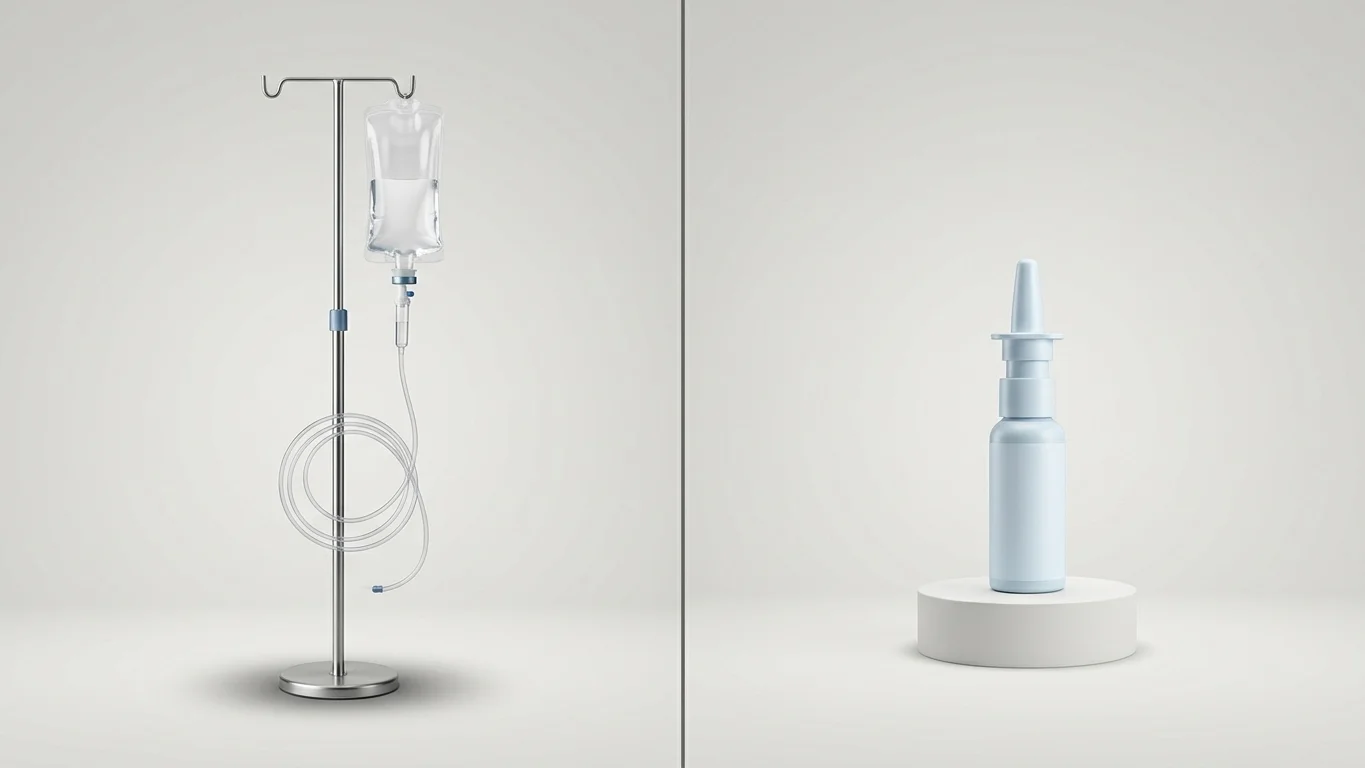
Ketamine and esketamine are closely related, but they should not be treated as the same depression treatment.
Ketamine is a racemic medication that has long been FDA-approved as an anesthetic. When IV ketamine is used to treat depression, that psychiatric use is off-label. Esketamine is one part of the ketamine molecule and is available as the prescription nasal spray Spravato.
Spravato is FDA-approved for treatment-resistant depression in adults, either by itself or with an oral antidepressant. It is also approved, with an oral antidepressant, for depressive symptoms in adults with major depressive disorder who have acute suicidal ideation or behavior.
Feature | IV Ketamine for Depression | Esketamine (Spravato) | Traditional Antidepressants |
FDA-approved for depression | No, psychiatric use is off-label | Yes, for specific adult depression indications | Many are FDA-approved |
How it is given | Usually IV infusion | Nasal spray | Usually oral tablets or capsules |
Onset | Can begin within hours | Improvement may begin early in treatment | Full benefit often takes several weeks |
Treatment frequency | Individualized | Follows an FDA-labeled induction and maintenance schedule | Usually taken daily |
Monitoring | Medical monitoring is important | Must be administered under healthcare supervision | Regular prescriber follow-up |
Long-term approach | No single standardized depression maintenance schedule | Frequency is reduced after induction based on response | Continued use depends on response and clinical plan |
Ketamine vs Traditional Antidepressants: How Is It Different?
Ketamine's main advantage is speed. Traditional antidepressants may take several weeks to show their full effect, while IV ketamine can reduce depressive symptoms much sooner in some people. However, faster does not automatically mean better for every patient.
Traditional antidepressants have much more long-term safety and effectiveness data for depression and are used across a wide range of depressive disorders. Ketamine is more often discussed when depression has not responded well to standard treatment.
The choice depends on diagnosis, previous medications, severity of symptoms, medical history, treatment availability, and clinician judgment. Ketamine should therefore be viewed as one possible treatment option rather than a replacement for all standard antidepressants.
Is Ketamine a Long-Term Solution for Depression?
Ketamine may be included in a longer-term depression treatment plan, but current evidence does not support describing one course of ketamine as a permanent solution. The strongest evidence involves rapid improvement during the first hours and days after IV treatment. Repeated administration can help maintain the initial response during active treatment, but longer-term outcomes after ketamine is stopped remain less certain.
A 2026 meta-analysis also concluded that longer-term outcomes are still not well established. For this reason, long-term care may involve monitoring, additional treatment when clinically appropriate, psychotherapy, other medications, and continued evaluation of depression symptoms.
The goal is not simply to make a single ketamine dose "last forever." The larger goal is to develop a treatment plan that supports stable improvement over time.
What Are the Risks and Side Effects of Ketamine?

Ketamine can cause side effects even when it is used medically. Safety depends on factors such as dose, route, health history, other medications, and the level of monitoring provided.
Short-Term Side Effects
Temporary effects may include dizziness, nausea, changes in perception, dissociation, sleepiness, and changes in blood pressure.
These effects often occur around the treatment period and may improve as the drug's immediate effects wear off. Patients should still be monitored because reactions can vary between individuals.
Safety Considerations
Ketamine is a Schedule III controlled substance and has the potential for abuse and misuse. Unsupervised or recreational use carries risks that are different from medically managed treatment.
Clinicians also need to consider cardiovascular health, substance use history, psychiatric history, current medications, and other medical factors before determining whether treatment is appropriate. Repeated or heavy nonmedical exposure has also been linked with urinary and bladder problems, which is another reason long-term use should not be treated casually.
Why Medical Oversight Matters
Ketamine treatment for depression should involve a qualified healthcare professional who can evaluate the patient, choose an appropriate approach, watch for side effects, and decide whether continued treatment is reasonable.
The rules for Spravato are even more specific. It must be administered under healthcare supervision and patients must be observed for at least two hours after administration because of risks including sedation, dissociation, respiratory depression, abuse, and misuse.
Who May Be Considered for Ketamine Therapy?
Ketamine is often discussed for adults with treatment-resistant depression, meaning depressive symptoms have not improved enough after appropriate standard treatments. Being diagnosed with depression does not automatically make someone a good candidate.
A clinician needs to review the person's diagnosis, treatment history, physical health, medications, substance use history, and other mental health conditions. Ketamine may not be appropriate for some people because certain medical or psychiatric conditions can increase treatment risks. The decision should therefore come after a complete clinical evaluation rather than from symptoms alone.
It is also important to determine which treatment is actually being considered. IV ketamine, compounded at-home ketamine, and FDA-approved intranasal esketamine have different evidence, dosing approaches, monitoring requirements, and regulatory status.
Ready to Find Out If Ketamine Therapy Is Right for You?
If you are still wondering how long ketamine works for depression, the answer can depend on your treatment history, symptoms, response to ketamine, and whether ongoing care is part of your plan. Some people notice changes quickly, while others may need a series of treatments before they can better judge how long the benefits last.
A personalized evaluation can help you understand what may be realistic for your situation instead of relying on a one-size-fits-all timeline. At Radiant Path Therapy in Grand Terrace, CA, our team can help you explore whether ketamine therapy may fit your needs and treatment goals. We can review your history, discuss how ketamine may work alongside other forms of care, and explain what to expect before, during, and after treatment.
If standard depression treatments have not provided the relief you hoped for, contact us today to learn more about your options and take the next step toward a treatment plan designed around your individual needs.
Conclusion
So, how long does ketamine work for depression? For some people, antidepressant effects can begin within hours of treatment. Following a single IV dose, research shows that improvement may continue for several days and can remain significant for about one week. Repeated treatment may help sustain the initial response, but there is no single timeline that applies to everyone.
How long ketamine treatment lasts also depends on the treatment method and the person's response. Continued treatment schedules should be individualized rather than assuming that everyone needs the same number of sessions or the same maintenance interval. For FDA-approved intranasal esketamine, for example, treatment frequency changes across induction and maintenance phases and is adjusted to the least frequent schedule needed to maintain response.
Improvements in daily functioning may also occur differently from improvements in mood. Sleep, concentration, work performance, motivation, and social engagement do not have one proven universal timeline. Some research suggests functional recovery can continue gradually over months even when depressive symptoms improve earlier.
Frequently Asked Questions
How long does ketamine last for depression after one session?
After a single session, most patients feel relief for about three to seven days. Some feel it longer, but one session alone is rarely enough to produce lasting results.
Is ketamine a permanent cure for depression?
No. Ketamine is not a cure. It reduces symptoms and creates a window for healing, but most patients need maintenance sessions to keep the effects going.
How often do you need ketamine treatments?
During the induction phase, patients usually receive six sessions over two to three weeks. After that, maintenance sessions are spaced out based on how long each person's relief lasts, typically every three to eight weeks.
Can ketamine stop working over time?
For some people, the effects can become less consistent over time. This is why combining ketamine with therapy is important. Therapy helps patients make lasting changes during the periods when ketamine is working.
Is ketamine safe for long-term use?
When used under medical supervision with proper dosing and monitoring, ketamine is considered safe. Recreational or unsupervised use is a different matter entirely and carries serious risks.
Who should not use ketamine for depression?
People with a history of psychosis, schizophrenia, active substance use disorder, or uncontrolled heart conditions are generally not good candidates. A full clinical evaluation is always the first step.


