

Cognitive Behavioral Therapy (CBT) can help with abandonment issues by changing the negative thoughts and fears that cause relationship anxiety. A therapist may help you question thoughts like “they will leave me,” manage strong emotions, and practice new ways of thinking and acting. Over time, these skills can help build self-confidence and healthier relationships.
Almost everyone has felt a flicker of this fear at some point, but for some people it becomes a constant presence that shapes how they date, how they respond to a friend who is slow to text back, or how safe they feel in a long term relationship. Left unaddressed, this fear can quietly wear down trust, self worth, and closeness over time.
If you are searching for support, Radiant Path Therapy and Psychiatry in Grand Terrace, CA works with people who struggle with these fears every day. This guide walks through what abandonment issues look like, what causes them, and how CBT can help you build a calmer, more confident way of relating to others.
What Are Abandonment Issues?
Abandonment issues are a deep fear of being left, rejected, or unimportant to the people you care about. This fear can show up in small daily moments or in bigger patterns that affect how you build relationships.
What Fear of Abandonment Can Feel Like
Fear of abandonment often feels like a constant worry that people will eventually leave, even without any clear reason to think so. It can show up as a tight feeling in your chest when someone does not respond right away, or a nagging thought that you are too much or not enough. For many people, it shows up as a low hum of unease that never fully goes away, even during good moments in a relationship.
Common Signs of Abandonment Issues in Adults
In adults, abandonment issues often look like needing constant reassurance, struggling to trust a partner’s commitment, or pulling away first to avoid being left. Some people overthink small changes in tone or behavior, searching for signs that something is wrong. Others may avoid closeness altogether, since staying distant feels safer than risking rejection later. These patterns can feel exhausting, since they take up so much mental energy without ever fully settling the underlying fear.
How Abandonment Issues Can Affect Children and Teens
Children and teens with abandonment fears may cling to a parent, act out when separated, or worry heavily about a caregiver not coming back. Some become overly independent at a young age, believing they cannot fully rely on others. These patterns often form after a loss, a major life change, or inconsistent caregiving during childhood. Left unaddressed, these early patterns can carry forward and shape how a person relates to others well into adulthood.
What Causes Abandonment Issues?

Abandonment issues usually do not appear out of nowhere. They tend to grow out of real experiences, especially ones that happen early in life or during emotionally difficult times.
Childhood Abandonment and Emotional Neglect
A child who grows up with a parent who is physically absent, emotionally distant, or inconsistent may learn early on that love and safety cannot be counted on. This can happen even in homes where basic needs are met, since emotional neglect is often less visible than physical neglect. As adults, they may find themselves repeating the same patterns of doubt in relationships that otherwise seem safe.
Loss, Rejection, and Relationship Breakups
Losing a parent, going through a painful breakup, or facing repeated rejection can all deepen a fear of abandonment. Each experience can reinforce the belief that people eventually leave, even when a new relationship has nothing to do with the past one. The fear tends to attach itself to new situations, even when there is no real reason for concern.
Trauma and Chronic Stress
Traumatic events, especially ones involving loss or betrayal, can leave a lasting mark on how safe someone feels in relationships. Chronic stress, like growing up in an unpredictable household, can also keep the nervous system on high alert for signs of danger or rejection. Over time, the body and mind can start treating everyday moments as potential threats.
Attachment Styles and Fear of Abandonment
Attachment styles develop early in life based on how consistently a caregiver responded to a child’s needs. Someone with an anxious attachment style may feel especially sensitive to any sign of distance in a relationship. It can also offer a helpful starting point for recognizing where certain reactions actually come from.
How Past Experiences Shape Core Beliefs
Painful past experiences often shape core beliefs like “I am not enough” or “people always leave.” These beliefs can feel like simple facts rather than learned patterns, even though they came from specific experiences rather than the full truth. Recognizing a belief as learned, rather than fixed, is often the first real step toward change.
How Cognitive Behavioral Therapy Helps With Abandonment Issues
CBT works by connecting thoughts, feelings, and behaviors, so changing one part can shift the whole pattern. It starts with noticing fear based thoughts like “they are going to leave me,” then testing how true those thoughts really are. This makes it easier to question them instead of just believing them.
From there, CBT helps replace unhelpful behaviors, like checking a partner’s phone, with steadier responses, while building simple coping skills like breathing or grounding. Over time, this practice helps replace fearful beliefs with more balanced ones, like “a disagreement does not mean the relationship is ending.” With repeated practice, these calmer beliefs start to feel just as natural as the old fears once did.
What Research Says About CBT for Abandonment Fears
While no large-scale trials study “abandonment issues” as a standalone diagnosis, since it isn’t a formal DSM-5 category, research on CBT for related conditions offers strong support for its use. A 2022 meta-analysis of randomized controlled trials found that CBT produced measurable improvements in anxiety-related disorder symptoms compared to placebo conditions, reinforcing its role as a well-established, evidence-based treatment for fear and anxiety patterns.
Attachment-specific research also supports this connection. A study on adults in a CBT-based group therapy program found that participants showed measurable improvement across most outcomes after treatment, with attachment anxiety levels at the start of therapy linked to treatment outcomes. This suggests CBT can meaningfully shift the emotional patterns tied to attachment-related fears, including those rooted in abandonment.
Common CBT Techniques for Abandonment Issues

CBT uses a specific set of tools and techniques to help people work through abandonment fears in a structured, practical way.
Identifying and Reframing Negative Thoughts
This technique involves catching automatic negative thoughts as they happen and rewriting them into more balanced statements. Instead of assuming a delayed text means someone is losing interest, a reframed thought might consider that the person is simply busy. Practicing this regularly can weaken the automatic pull of fear based thinking. Over time, reframing becomes a quicker, more natural response instead of a deliberate effort.
Challenging Core Beliefs About Rejection and Worth
Deeper beliefs, like feeling fundamentally unworthy of love, often sit underneath specific fears. CBT works to slowly test and challenge these beliefs using real evidence from a person’s life. This process can take time, but it often leads to meaningful shifts in self worth. As these deeper beliefs soften, many of the smaller daily fears tend to ease as well.
Exposure to Fears in a Safe and Gradual Way
Gradual exposure involves facing feared situations, like being apart from a partner for a set period, in small and manageable steps. This helps someone learn through direct experience that the feared outcome, like being abandoned, does not actually happen. Over time, this reduces the intensity of the fear itself. Each successful step builds confidence for the next, slightly bigger one.
Behavioral Experiments and New Relationship Experiences
Behavioral experiments involve testing out a belief in real life to see what actually happens. For example, someone might try expressing a need directly instead of assuming it will be dismissed. These small experiments often provide powerful evidence that challenges old, fear based assumptions. Over time, they help replace assumption with actual lived experience.
Journaling and Thought Records
Thought records are a simple tool for writing down a triggering situation, the thought that followed, and a more balanced alternative. This practice helps build awareness of patterns that might otherwise go unnoticed. Over time, journaling can reveal just how often fear based thoughts show up without solid evidence behind them. Reviewing old entries can also show clear progress that might be easy to miss day to day.
Coping Skills for Anxiety and Emotional Distress
CBT often includes practical coping skills like deep breathing, grounding exercises, or short pauses before reacting to a triggering moment. These tools help create space between a feeling and a reaction, which can prevent old patterns from taking over. With practice, these skills become easier to use in real, high stress moments. Over time, they can become second nature rather than something that requires conscious effort.
How CBT Can Help With Fear of Abandonment in Relationships
Abandonment fears often show up most strongly in close relationships, where the stakes feel highest. CBT helps people notice when jealousy or the need for reassurance is coming from fear rather than an actual problem, giving them space to pause and check whether the fear matches reality. It also helps build a gap between the initial spike of anxiety and how someone chooses to respond, which can stop small, ordinary moments from turning into bigger conflicts.
CBT also encourages direct, honest communication instead of assuming the worst about a partner’s actions, which often leads to stronger trust over time. It helps identify whether someone tends to pull away completely or hold on too tightly, and works to build a steadier middle ground between the two. Alongside this, CBT supports building a stronger sense of identity outside the relationship, so a person can feel secure even when a partner needs space, which often reduces the intensity of abandonment fears overall.
Other Therapies That May Help With Abandonment Issues
CBT is not the only approach that can help with abandonment issues. Depending on someone’s history, other types of therapy may also play an important role.
Dialectical Behavior Therapy (DBT)
DBT focuses heavily on emotional regulation and distress tolerance, which can be especially helpful for people who feel overwhelmed by intense emotional swings. It teaches specific skills for managing crisis moments without acting on impulse. Many people use DBT alongside CBT for added support. This combination can be especially useful for those who feel emotions very intensely.
Attachment-Based Therapy
Attachment based therapy looks closely at early relationship patterns and how they continue to shape adult behavior. This approach can help someone understand the roots of their fear in a deeper, more personal way. It often works well alongside the practical tools used in CBT. Together, these approaches can address both the origin of the fear and the daily patterns it creates.
Trauma-Focused Therapy
For people whose abandonment fears are tied to significant trauma, trauma focused therapy can help process those experiences directly. This approach often works through the emotional weight of past events in a structured, supportive way. Addressing trauma directly can make other therapy work more effective. Without this step, some people find that other techniques only address the surface of the problem.
EMDR and Other Trauma Treatments
EMDR, or eye movement desensitization and reprocessing, is another option for people whose abandonment fears are linked to specific traumatic memories. This approach helps the brain process difficult memories so they feel less overwhelming. It is often used alongside other therapy approaches rather than on its own. Many people find it especially helpful for memories that feel stuck or unusually intense.
Family Therapy for Childhood Abandonment
When abandonment issues are rooted in family dynamics, family therapy can help address patterns directly within that system. This can be especially helpful for teens or young adults still living at home. It also gives family members a chance to understand and support the healing process. Involving the whole family can help create a more consistent, supportive environment moving forward.
Exercises and Coping Strategies You Can Practice
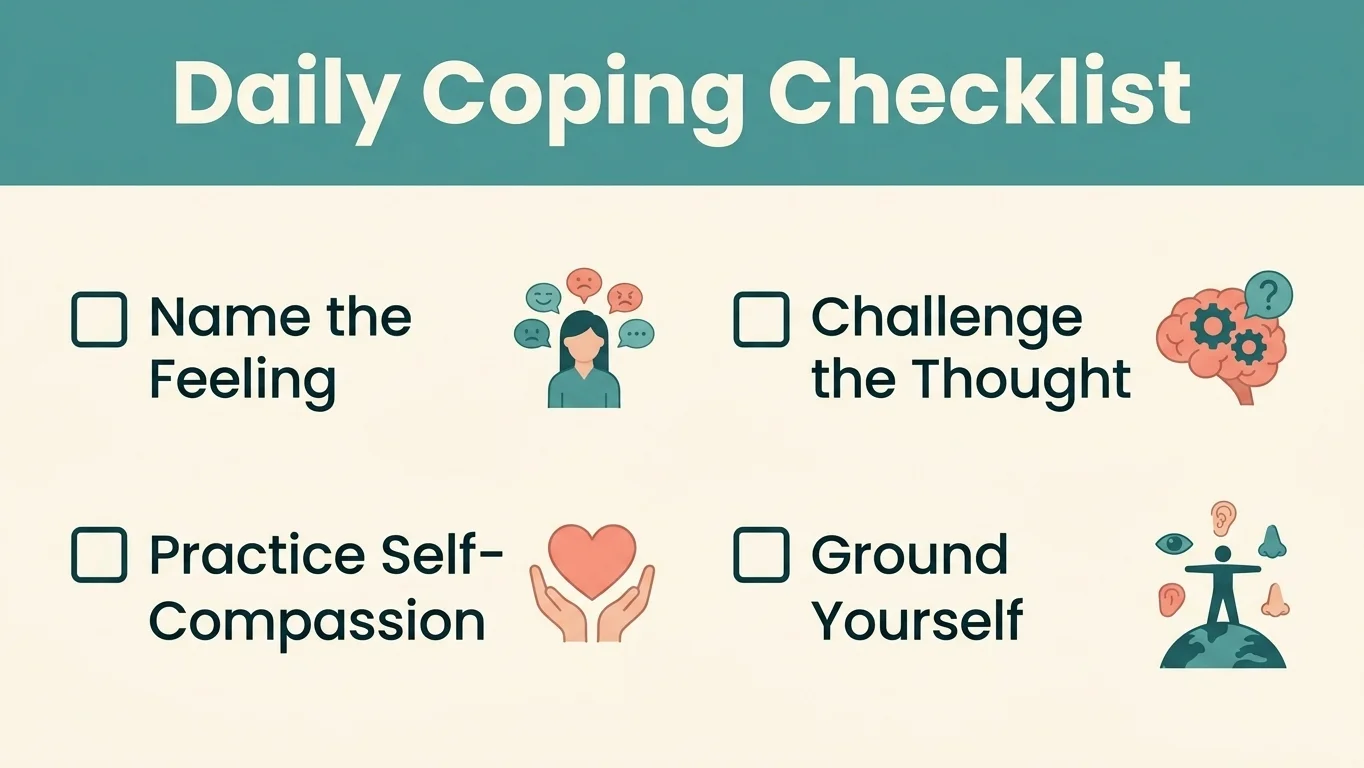
Alongside formal therapy, there are practical exercises that can support healing from abandonment fears in everyday life.
| Strategy | What It Involves | How It Helps |
|---|---|---|
| Acknowledge and Name Your Feelings | Simply naming a feeling, like saying “I feel afraid of being left right now” | Creates distance between the emotion and an automatic reaction, making it easier to respond calmly |
| Challenge Abandonment-Related Thoughts | Asking what evidence actually supports a fear based thought when it shows up | Interrupts the automatic spiral that often follows a triggering moment |
| Practice Self-Compassion | Speaking to yourself with the same kindness you would offer a friend | Softens the harshness of abandonment fears without ignoring the pain |
| Build Healthy Support Systems | Keeping a few steady, trusted people in your life | Balances out fears connected to any one relationship and eases pressure on it |
| Work Through Grief and Past Loss | Taking time to acknowledge and grieve past losses instead of pushing them aside | Lightens the hold these losses have on current relationships |
| Use Grounding and Emotional Regulation Skills | Noticing five things you can see or feel in the moment | Calms an anxious nervous system, especially during high emotional intensity |
Which Approach Fits Your Situation?
Every abandonment fear looks a little different, and the right therapy often depends on where the fear is coming from. The table below offers a quick starting point for matching common experiences to the approaches most likely to help, though a therapist can offer more personalized guidance based on your specific history.
| If Your Fear Comes From… | Consider… | Why It Helps |
|---|---|---|
| Everyday relationship anxiety and distorted thinking patterns | Cognitive Behavioral Therapy (CBT) | Targets fear-based thoughts directly and replaces them with balanced, realistic ones |
| Intense emotional swings, impulsivity, or difficulty tolerating distress | Dialectical Behavior Therapy (DBT) | Builds emotional regulation and distress tolerance skills for crisis moments |
| Deep-rooted core beliefs like “I’m unlovable” or “I’m not enough” | Schema Therapy | Works to identify and rebuild long-standing negative core beliefs at their root |
| A specific traumatic memory tied to loss or rejection | EMDR | Helps the brain reprocess distressing memories so they feel less overwhelming |
| Childhood relational patterns still shaping adult behavior | Attachment-Based Therapy | Explores early attachment patterns and how they continue to play out today |
How to Know When You Need Professional Help
Some abandonment fears can be managed with self help tools, but others benefit from working with a trained therapist. If these fears are affecting your sleep, focus, or daily functioning, it may be a sign that professional support could help, since they can quietly take up a lot of mental and emotional energy. The same is true if these fears are creating repeated conflict, pushing people away, or making it hard to build lasting relationships.
Getting support early can stop these patterns from becoming even more deeply set over time, and it can help protect relationships that still have real potential. This becomes especially important when anxiety, depression, or symptoms related to past trauma show up alongside abandonment fears, since a therapist can help address the full picture rather than just one piece of it.
How to Choose the Right CBT Therapist
Finding a therapist who’s the right fit can shape how effective your CBT journey feels, especially when working through something as personal as abandonment fears and attachment wounds. The therapeutic alliance, or the rapport between you and your therapist, is itself a research-backed factor that influences treatment outcomes, so asking a few thoughtful questions before your first session can help you find the right mental health professional for your needs.
Questions to Ask Before Your First Session
Are you trained or certified in Cognitive Behavioral Therapy? Not every licensed therapist, whether an LCSW, LMFT, LPC, or PsyD, practices CBT as a structured, evidence-based modality. Some follow an integrative or eclectic approach instead, so it helps to confirm directly which therapeutic framework their training is rooted in.
Do you have experience working with attachment issues or trauma? Abandonment fears are often connected to anxious attachment, avoidant attachment, or unresolved childhood relational trauma, so specific clinical experience in this area can make sessions feel more targeted and effective.
What does a typical session look like, and how often would we meet? Understanding the session structure, cadence (such as weekly or biweekly), and overall treatment plan upfront helps set realistic expectations for the work ahead.
Do you use tools like thought records or behavioral experiments? These are core CBT techniques, and asking about them gives you a sense of how hands-on and skill-based the therapist’s approach is. Homework assignments, self-monitoring, and between-session practice are usually part of this same structured method.
How do you track progress over time? Understanding what healing looks like and how measurable treatment goals are defined gives you clarity on how improvement will actually be assessed.
Additional tip: Practical factors like session cost, insurance coverage (in-network versus out-of-network), and the availability of telehealth or in-person sessions are also worth clarifying early on. These details help support long-term consistency, which matters especially for a skill-based therapy like CBT.
Can Abandonment Issues Be Healed?
Abandonment issues are not permanent, and with the right support, real healing is possible over time. Healing often looks like feeling less reactive to small relationship bumps and trusting people more easily, even if the fear does not disappear completely. There is no set timeline for this, since some people notice shifts within a few months while others need longer term support, and progress usually builds gradually rather than all at once.
Each small step, like challenging a fear based thought or trying a new behavior, adds up over time. Signs of real progress include feeling less anxious during normal ups and downs, needing less reassurance, and feeling okay with some distance from a partner without assuming the worst.
Ready to Start Healing?
If you recognize yourself in any of the patterns described here, know that support exists and change is possible, no matter how long you have been carrying this fear. Radiant Path Therapy and Psychiatry in Grand Terrace, CA offers evidence based care, including CBT, for people working through abandonment fears, relationship anxiety, and trauma.
Reach out today to schedule a consultation with our team and take the first step toward healthier, more secure relationships. You do not have to figure this out on your own.
Conclusion
Fear of abandonment can feel like something you have to carry alone, but it does not have to stay that way. Cognitive behavioral therapy gives people real, practical tools to understand where these fears come from, whether that is childhood experiences, past loss, or an anxious attachment style, and how to respond to them differently instead of being ruled by old, automatic thoughts.
Healing is rarely instant, and that is completely normal. Progress tends to happen through small, repeated moments, like catching a fear based thought before it spirals or choosing to communicate instead of withdrawing, and over time these small shifts add up to a stronger sense of security in yourself and in your closest relationships.
Frequently Asked Questions
Can CBT Help With Fear of Abandonment?
Yes. CBT is one of the most effective, well researched approaches for working through abandonment fears, since it directly targets the thoughts and behaviors that keep the fear active. It gives people practical tools they can use both in and out of session, like reframing negative thoughts and testing fears against real evidence. Over time, this can lead to real, lasting change in how safe someone feels in their relationships.
What Is the Best Therapy for Abandonment Issues?
CBT is often a strong first choice, since it offers clear, structured tools for managing fear based thoughts and behaviors. That said, attachment based therapy, trauma focused therapy, and DBT can also help, especially when used alongside CBT. The right approach often depends on what is driving the fear in the first place.
What Is the Root Cause of Fear of Abandonment?
Fear of abandonment often comes from early childhood experiences, inconsistent caregiving, loss, or trauma that shaped a belief that relationships cannot be fully trusted. It can also develop later in life after a painful breakup or repeated rejection. These roots are not always obvious without some guided reflection.
Does Fear of Abandonment Ever Go Away?
For many people, the fear becomes much smaller and easier to manage, even if it does not disappear completely. With ongoing practice, it tends to have far less control over daily life and relationships as time goes on. Most people describe this as feeling like themselves again, rather than feeling like the fear has fully disappeared.
How Do Abandonment Issues Affect Relationships?
Abandonment issues can lead to jealousy, constant reassurance seeking, or difficulty trusting a partner. Left unaddressed, these patterns can slowly wear down closeness and trust, even in otherwise healthy relationships. Working through these fears with support can help both people feel more secure and understood.
Is It Normal to Have Abandonment Issues as an Adult?
Yes. Many adults carry some degree of abandonment fear, often rooted in earlier life experiences like childhood neglect, loss, or past relationship pain. Having these fears does not mean something is wrong with you or that you are incapable of healthy relationships. Support is available whenever you are ready for it.
How Can I Overcome Childhood Abandonment Issues?
Working with a therapist trained in CBT or attachment based approaches is one of the most effective ways to address childhood abandonment issues and build healthier patterns as an adult. Therapy can help connect current struggles back to their roots, making the patterns feel less confusing. With consistent effort, old childhood wounds often start to carry much less weight in adult relationships.