
Couples Therapy for ADHD: The Complete Guide to Healing Your Relationship
Most couples don't realize ADHD is behind their problems until years of hurt have already built up. One partner is exhausted. The other is ashamed. The fights feel personal, but the real cause is a brain that works differently. Couples therapy for ADHD looks at how attention, impulse control, and emotion affect talking, trust, and closeness between partners. It treats ADHD as a brain difference, not a character flaw. That one shift changes everything about how therapy works.
At Radiant Path Therapy, our therapists work with many couples whose fights, broken trust, or growing distance are tied to ADHD. ADHD also brings real strengths. Creativity, humor, spontaneity, and deep loyalty often drew partners together in the first place. Good therapy does not erase these traits. It keeps what works and builds structure around what does not.
Why ADHD Affects Relationships So Much
ADHD symptoms hit hardest at home, the one place where two people share everything. Inattention, impulsivity, and poor follow-through aren't occasional; they're daily. A missed bill or forgotten promise rarely happens once. Over years, small moments stack up into resentment on one side and shame on the other.
The numbers reflect this. Couples where one or both partners have ADHD face a 30 to 50 percent higher divorce risk. Nearly 60 percent report real strain when ADHD goes untreated.
These aren't predictions. They show what happens when ADHD goes unrecognized for years. Named and treated, outcomes tend to improve. That's the point of ADHD-focused couples therapy.
How ADHD Shows Up in Everyday Relationship Problems
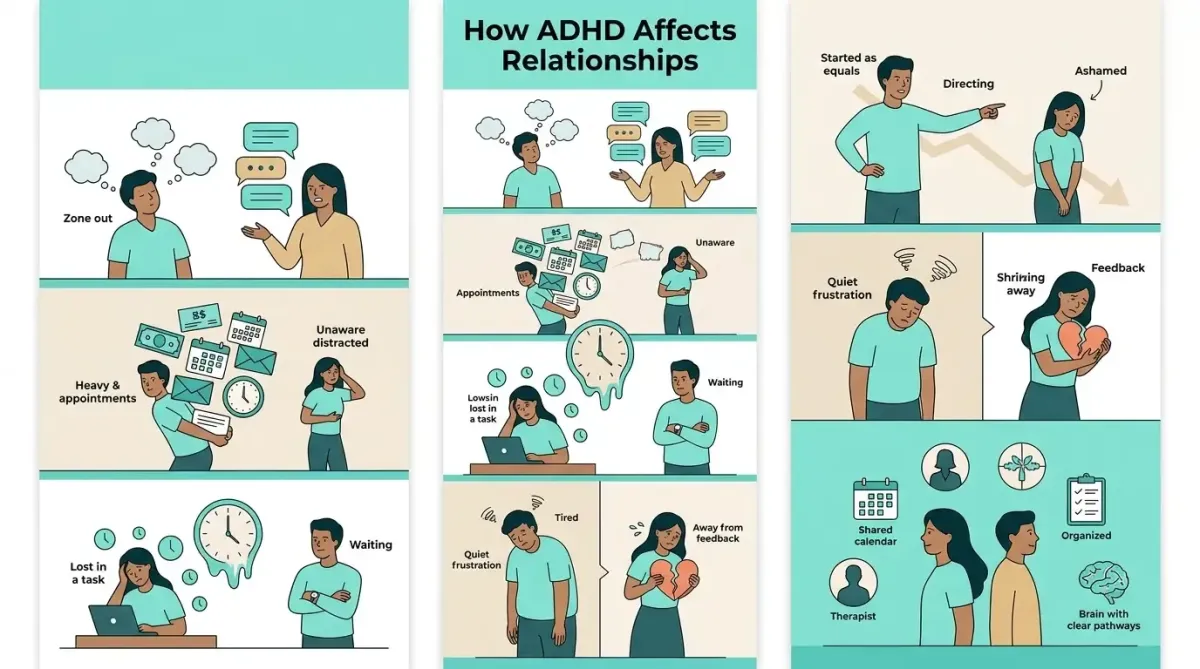
ADHD shows up as a few repeating patterns: communication breakdowns, an uneven workload at home, constant lateness, and a drop in closeness. These are not random complaints. Each one traces back to a specific ADHD symptom.
Communication Problems
The ADHD partner may interrupt or zone out; the other feels unheard and repeats themselves. Long emotional talks are harder when focus and impulse control are affected. Over time this creates a pattern where one partner raises issues and the other shuts down, and nothing gets resolved.
Unequal Load at Home
The non-ADHD partner often handles bills, schedules, and appointments by default. This isn't about caring less. ADHD impairs executive function, the brain's planning system, making it genuinely hard to manage these tasks. The weight is real but invisible to the partner carrying less of it.
Forgetting and Lateness
ADHD affects time perception. Being late isn't rudeness; the brain simply doesn't track time the way others do. Hyperfocus makes this worse: a partner can lose hours on one task while the other waits, feeling forgotten.
Losing Closeness Over Time
Early on, hyperfocus can make a partner feel intensely desired. Later, that focus shifts elsewhere. A 2024 research review found many adults with ADHD struggle with physical intimacy, linked to hyperfocus and sensory sensitivity.
Rejection-sensitive dysphoria adds another layer. A small suggestion can feel like total failure, causing the ADHD partner to withdraw. It's not about attraction; it's about pain.
The "Parent and Child" Pattern Many ADHD Couples Fall Into
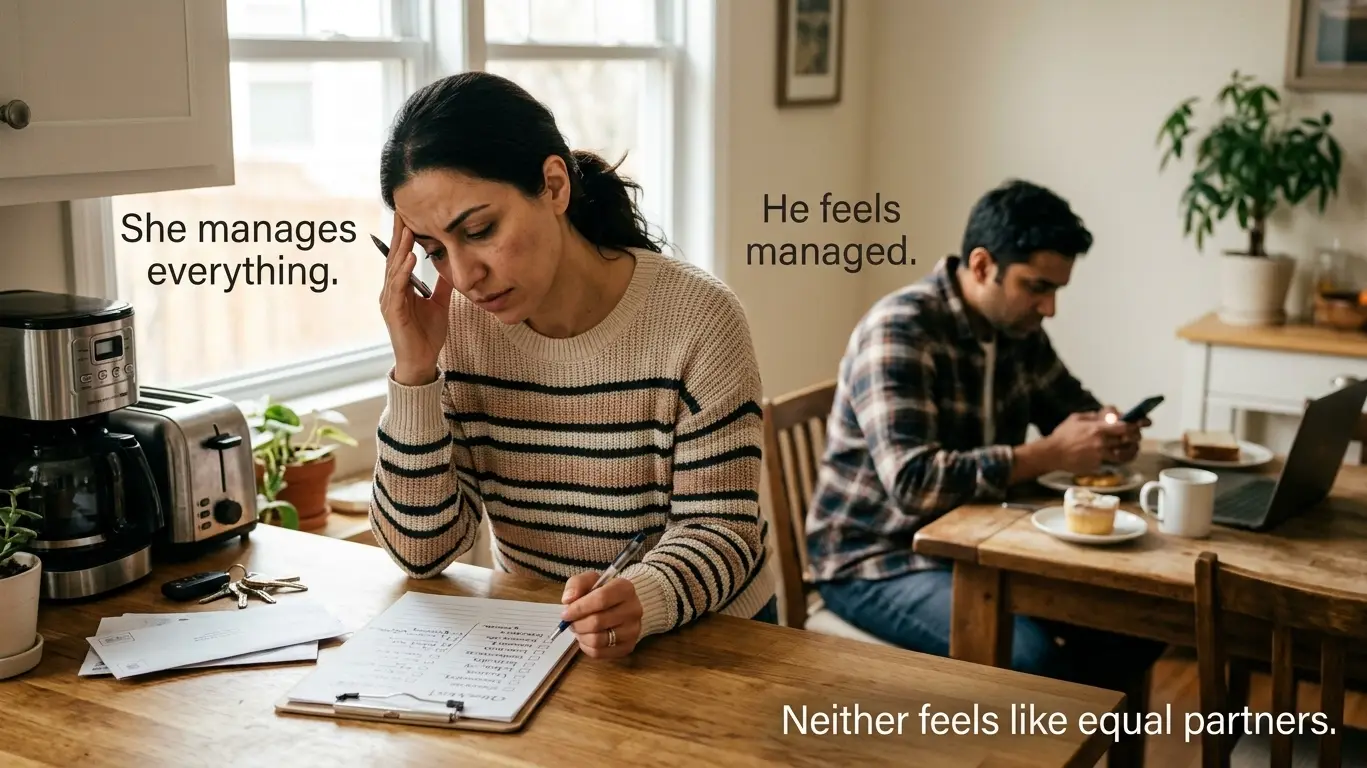
The parent-child pattern is the most common dynamic in ADHD relationships. It usually forms in three steps:
The ADHD partner does not follow through in a steady way. This is not from a lack of caring. It comes from real struggles with planning and follow-through.
The other partner takes over more tasks to keep daily life running.
The other partner starts reminding and correcting the ADHD partner, the way a parent would. Bad feelings build up on both sides. Attraction fades.
Breaking this pattern takes more than trying harder at the same old approach. Both partners need to build a new structure. One partner takes real ownership of tasks. The other partner learns to step back.
How Each Partner Usually Feels
Both partners feel real pain, but it shows up differently for each person.
Understanding both sides is usually the first breakthrough in therapy. A 2024 survey of 700 couples affected by ADHD found something striking. 38 percent of the partners with ADHD said their relationship had come close to divorce. Partners without ADHD felt even more strain. Only 24 percent of them said divorce had never crossed their mind.
Does ADHD Increase the Risk of Divorce?
Yes. Couples where one or both partners have ADHD face a 30 to 50 percent higher divorce risk than other couples. Several studies link untreated ADHD to less happiness in marriage and a higher chance of breaking up. The real cause is almost always untreated symptoms, not the diagnosis itself.
A 2017 study published in the Journal of Child and Family Studies compared spouses of people with ADHD to spouses of people without it. Spouses of partners with ADHD were much less happy in their marriage. Low closeness was a key reason why.
This points to something hopeful. Closeness and connection are things couples can rebuild. ADHD itself does not end relationships. Patterns that go untreated do. And patterns can change with the right support.
Why Normal Couples Counseling Doesn't Always Work
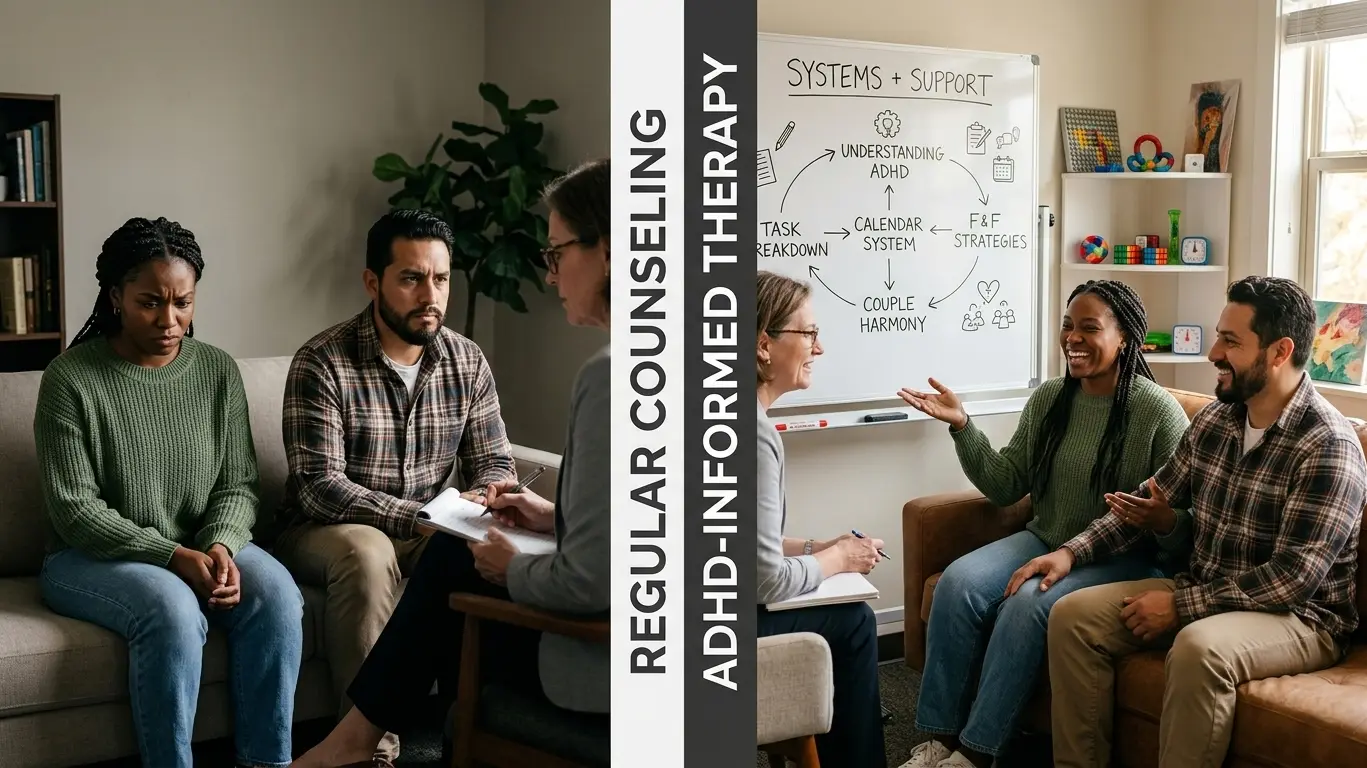
Standard counseling assumes problems come from choices or past wounds, not brain differences. A therapist without ADHD training may read poor follow-through as low motivation when it's actually a planning and focus problem.
Typical tools, talking it out, making a plan, holding each other accountable, all assume that agreeing leads to doing. For ADHD couples, agreement is rarely the issue. The ADHD partner often wants to follow through and still can't. Plans fall apart within weeks.
The risk is real. Uninformed therapy can validate the non-ADHD partner's frustration while deepening the ADHD partner's shame. Couples can go through multiple rounds of therapy and leave feeling worse, simply because no one identified the actual cause.
What an ADHD-Informed Couples Therapist Does Differently
An ADHD-informed therapist treats ADHD like a third presence in the room. It is not seen as one partner's fault. This change shapes how sessions run. It also shapes which tools get used.
Explaining the Real Reason Behind the Behavior
Both partners learn how ADHD affects attention, time, and emotion. This helps the non-ADHD partner stop reading forgetfulness as rudeness, and helps the ADHD partner understand their patterns without shame. Therapists often explain the dopamine link: motivation drops quickly once a reward fades, which is why boring tasks get avoided repeatedly.
Making ADHD the Problem, Not Your Partner
Therapists use a technique called externalizing, separating the person from the problem. The question shifts from blame to strategy: "How is ADHD getting in the way, and what can we build around it?" This moves couples into solving something together instead of fighting each other.
Setting Up Systems Instead of Just Talking
Talking alone rarely changes ADHD-related habits. Real progress comes from structure: shared calendars, visible chore charts, weekly check-ins. These work because they reduce reliance on memory and willpower, the two things ADHD makes least dependable.
Sessions are also structured differently. Shorter segments, real-life examples, and written takeaways tend to work better than extended open-ended conversation.
Common Problem Areas in ADHD Relationships
ADHD tends to focus conflict around four areas: money, screens, parenting, and intimacy. Couples often avoid these topics because each one carries shame. These are also the areas where therapy tends to bring the fastest relief.
Money Problems and Impulsive Spending
ADHD's link to acting on impulse often shows up in spending too. Untreated ADHD is linked to up-and-down income. It is also linked to spending without a plan. Researcher Gina Pera and psychologist Arthur Robin built a model for ADHD couple therapy. It names money as a major hot spot. It suggests automatic transfers and spending alerts. These work better than willpower alone.
Phone and Gaming Habits Hurting Your Relationship
ADHD comes with a strong pull toward habits that are hard to stop. This includes gaming and social media. When one partner keeps choosing a screen over time with their partner, the other partner can feel replaced. Therapy here focuses on spotting the times of day when this happens most. It also focuses on building other outlets, not just asking for less screen time.
Parenting Together When ADHD Is Involved
Parenting together gets harder when one or both parents have ADHD. Part of the reason is that ADHD runs in families. So children of parents with ADHD are more likely to have it too. Staying steady matters most in parenting. That is exactly what untreated ADHD makes hard. Written, shared parenting plans help, since they do not rely on memory alone.
Rebuilding Physical Closeness
Rebuilding closeness starts with telling two things apart. People often confuse low desire with a limited ability to stay focused. Therapists work on naming rejection-sensitive dysphoria triggers directly. This way, feedback during private moments does not get misread as criticism. Planning closeness around each partner's natural energy, instead of a fixed schedule, also helps.
Why ADHD Treatment Should Be Part of the Plan
Couples therapy works best alongside individual ADHD treatment, like medication or coaching. It should not replace it. Therapy alone, without treating the ADHD directly, tends to move slower. It also tends to have weaker results.
This approach treats the person, the couple, and their daily systems all together. The partner with ADHD gets individual treatment. The couple works on shared patterns in therapy. Both partners build outside systems that take pressure off memory.
Is Getting Diagnosed as an Adult Worth It?
Yes, for most adults whose relationship struggles are tied to ADHD symptoms. A diagnosis opens the door to medication. It also brings a clearer understanding of what is going on. It lowers shame too. Years of "why can't I get it together" become something real and treatable.
A formal diagnosis is not required to start therapy. Many therapists begin working on communication and systems while testing is still going on.
Could Medication Be Affecting Your Relationship?
Medication can truly help with acting on impulse, forgetfulness, and strong emotional reactions. It can also bring side effects, like crankiness or changes in interest in being physically close. If a partner's mood shifts after starting or changing a dose, it is worth talking to their doctor directly.
Medication treats attention and impulse control. On its own, it does not undo years of patterns like the parent-child pattern. That is the part therapy is built to handle.
When Your Situation Is a Bit Different
Not every ADHD relationship fits the standard mold. These situations need a slightly different approach.
When Both of You Have ADHD
When both partners have ADHD, household problems often pile up. Neither partner naturally takes on the organizing role. Conflict tends to look like both partners feeling overwhelmed, instead of a clean parent-child split. Therapy here leans heavily on outside systems. Sometimes it also includes outside help, like hiring a household manager.
When Autism Is Also Part of the Picture
AuDHD is the term for having both autism and ADHD. It adds extra layers around sensory needs and communication style. A therapist who understands both conditions tends to get better results with these couples. This works better than treating one condition as background noise.
When You Suspect ADHD but Aren't Diagnosed
Couples can still benefit from therapy before a diagnosis is confirmed. Many communication tools and systems help no matter what the diagnosis is. Testing can happen alongside therapy instead of before it.
How to Pick a Therapist Who Understands ADHD
The right therapist has specific training in adult ADHD. General experience with couples counseling is not enough. Searching "couples therapist near me" often turns up skilled therapists who still lack this training. That is why it is worth asking directly.
At Radiant Path Therapy, our clinical team includes therapists trained in EMDR, CBT, and DBT. They work with couples facing ADHD, anxiety, and trauma together. Clinical Director Tiffany Komba, LMFT, brings years of experience to our couples work. Her background includes family systems and dual diagnosis care.
We see couples in person across California. We also offer telehealth sessions for anyone who prefers meeting from home. Telehealth appointments currently accept PPO insurance. Many couples can start within the same week.
Questions to Ask Before Your First Session
Before booking, ask a prospective therapist these five questions.
What specific training do you have in adult ADHD?
How do you explain ADHD's role in conflict to couples?
Does a session include practical tools, not just talk?
How do you avoid making the ADHD partner the problem?
Do you coordinate with medication management or coaching?
A good therapist answers these questions clearly. Vague answers are a warning sign. Clear answers mean you are more likely to get care that helps.
Therapy or ADHD Coaching: Which Do You Need?
Couples therapy and ADHD coaching serve different purposes. They work best together. Therapy focuses on the relationship between partners. Coaching focuses on building individual skills, like organization and follow-through, for the partner with ADHD.
Melissa Orlov and other ADHD relationship experts recommend doing both. Coaching alone skips the trust and hard-feelings piece. Therapy alone skips the skill-building that stops the same patterns from happening again.
What to Expect in Your First Few Sessions
Early sessions focus on naming the couple's specific cycle, then shift to practical tools. Many couples see fewer big arguments within the first month, often just from having words to describe what's happening.
Deeper change, especially around the parent-child dynamic, takes several months. Progress is uneven: improvement, then a setback, then more progress. That's normal, not failure.
If only one partner attends, it can still shift things. Changing how one person responds to a pattern often changes the pattern itself.

When to Seek Help, Even If You're Considering Separation
Look for ADHD-informed couples therapy as soon as you notice a repeating cycle. This cycle often looks like criticism, defensiveness, or pulling away. Do not wait until the relationship feels impossible to save. These patterns rarely stay the same on their own. Without help, they tend to get worse.
Even couples who are seriously thinking about separating often find real hope. This happens once ADHD's role is named. Much of what feels like being a bad match is really just a pattern. And patterns can be treated and changed.
Therapy at this stage is not about forcing the relationship to survive. It gives both partners clear information. They can then decide from a place of understanding, not exhaustion.
Let ADHD Couples Therapy Help You Both Feel Heard Again
When ADHD goes unaddressed, one partner wears out and the other fills up with shame. Most couples stay stuck in that cycle for years because no one ever named the real cause. At Radiant Path Therapy in Grand Terrace, CA, our therapists help both of you understand what ADHD is doing to your relationship and build something that actually works for both partners. In-person sessions across California and telehealth available with PPO insurance. Book your first session this week before the pattern gets harder to break.
Frequently Asked Questions
Can couples therapy work if only one partner has ADHD?
Yes. Most ADHD couples have only one diagnosed partner. ADHD-informed therapy is built exactly for this. Both partners learn how ADHD is driving the conflict, not just the one who has it.
What if my partner won't go to couples therapy?
Start without them. Changing how one partner responds to a pattern often changes the pattern itself. Many partners come around once they see things improving.
Is ADHD couples therapy different from regular marriage counseling?
Yes. Regular counseling focuses on choices and communication. ADHD-informed therapy focuses on how the brain drives conflict. Without that lens, the real cause goes unnamed and the same fights keep happening.
Should we get diagnosed before starting couples therapy?
No. A diagnosis is not required to start. Most therapists begin working on communication and systems while testing is still in progress.
Does ADHD medication help the relationship, or just the individual?
Mainly the individual, but the relationship benefits too. Medication reduces impulsivity, forgetfulness, and emotional reactivity. That takes real pressure off the relationship. It does not undo years of patterns though. That is what therapy is for.
How long does couples therapy for ADHD typically take?
Most couples see fewer arguments within the first month. Deeper pattern change, like breaking the parent-child dynamic, takes several months. Progress is uneven but that is normal, not failure.
Is ADHD couples therapy covered by insurance?
Coverage varies by plan. At Radiant Path Therapy, telehealth sessions accept PPO insurance. Our team can check your coverage before your first appointment.


