

Therapy for emotional immaturity teaches emotion regulation, the skill of managing feelings before they drive what you do, and adults can learn it at any age. The right approach depends on your main pattern, and a licensed therapist with training in that method should check for conditions like ADHD first.
DBT works best for intense emotional reactions and acting on impulse, and CBT helps with defensiveness and blame. Couples therapy helps with patterns that show up with a partner, while schema therapy or EMDR targets reactions rooted in childhood or trauma. At Radiant Path Therapy and Psychiatry in Grand Terrace, CA, we help adults react differently in their closest relationships.
Can Therapy Help Emotional Immaturity?
Yes. Emotional immaturity mostly comes down to emotion regulation, your ability to notice, understand, and manage feelings before they drive what you do. Therapy teaches it as a set of skills you practice, and a long history doesn’t mean a pattern can’t change. Older patterns usually just take longer to change.
In a 2024 systematic review of 18 randomized trials, researchers found that CBT, DBT, mindfulness programs, and the Unified Protocol (a skills-based treatment for emotional problems) each improved emotion regulation by a moderate amount during treatment. Because the trials differed in design, the authors treat those gains as promising rather than final.
Myths and Facts About Emotional Immaturity
| Myth | Fact |
| Emotional immaturity is a fixed personality trait. | Emotion regulation responds to treatment. The 2024 review of 18 trials found moderate gains during therapy. |
| Only medication can calm strong mood swings. | Every therapy in that 2024 review was a talk or skills therapy, and each one improved emotion regulation. |
| Emotional immaturity is a mental health diagnosis. | It doesn’t appear in the DSM-5-TR, the manual US clinicians use to diagnose mental health conditions. |
What Is Emotional Immaturity?
Emotional immaturity means reacting in ways that don’t match the situation. Common examples include strong anger over a minor comment, difficulty admitting a mistake, or shutting down during a difficult conversation. Clinicians call this difficulty with emotion regulation.
Psychologists Kateri McRae and James Gross define emotion regulation as the efforts you make to influence your own emotions or other people’s. Everyone loses that balance sometimes, but it matters when the same fights keep coming back. A 2026 review of 619 studies found emotion regulation difficulties in almost every mental health condition it examined, which is why a careful assessment matters.
Where These Patterns Come From
Most of these patterns start in childhood. Children learn to handle feelings by watching how their caregivers respond to them. When a parent ignores, dismisses, or punishes emotions, the child never practices naming and calming them, and that gap follows them into adult relationships. A 2023 review of 36,141 people found childhood emotional neglect among the strongest predictors of adult alexithymia, which means trouble identifying and describing your own feelings.
Other roots include emotional abuse, insecure attachment, trauma, and conditions like ADHD. A 2018 study of 500 college students linked emotional abuse to impulsive reactions and emotional neglect to trouble understanding feelings. None of this puts all the blame on your parents or means you’re stuck, because many reactions made sense where they started.
5 Common Signs of Emotional Immaturity in Adults
You may recognize 1 or 2 of these signs strongly and the others only a little. A sign becomes a pattern when it shows up week after week, across different relationships, and repair rarely follows.
Overreacting to Small Things
A late reply or a small criticism leads to anger, panic, or tears that feel out of proportion, even to you. Afterward, it takes you much longer to calm down than the moment itself lasted.
Getting Defensive and Blaming Others
Feedback feels like an attack. You start building a counterargument before the other person finishes, or you shift the focus to what they did wrong, so taking responsibility feels hard.
Pulling Away During Hard Conversations
You stop talking, change the subject, or leave the room when a conversation gets heated. To you, it feels like keeping the peace. To the other person, it can feel like rejection.
Struggling to See the Other Person’s Side
During an argument, your own feelings take over. You may love the person deeply and still struggle to imagine how the moment felt for them.
Acting on Impulse
You send the text, slam the door, or make the purchase before the feeling has a chance to pass. When emotions run high, you act first and regret it later.
Common mistake: Calling yourself “immature.” A label adds shame. Naming the pattern, such as “I stop talking when someone raises their voice,” gives you something specific to work on.
When to Get Help Right Away
Some warning signs need professional help today. Reach out to a professional now if anger turns into threats or physical harm, if anyone feels unsafe at home, or if you have thoughts of hurting yourself. You can call or text 988 to reach the 988 Suicide & Crisis Lifeline at any hour. If someone faces immediate danger, call 911.
Which Therapy Fits Your Pattern?
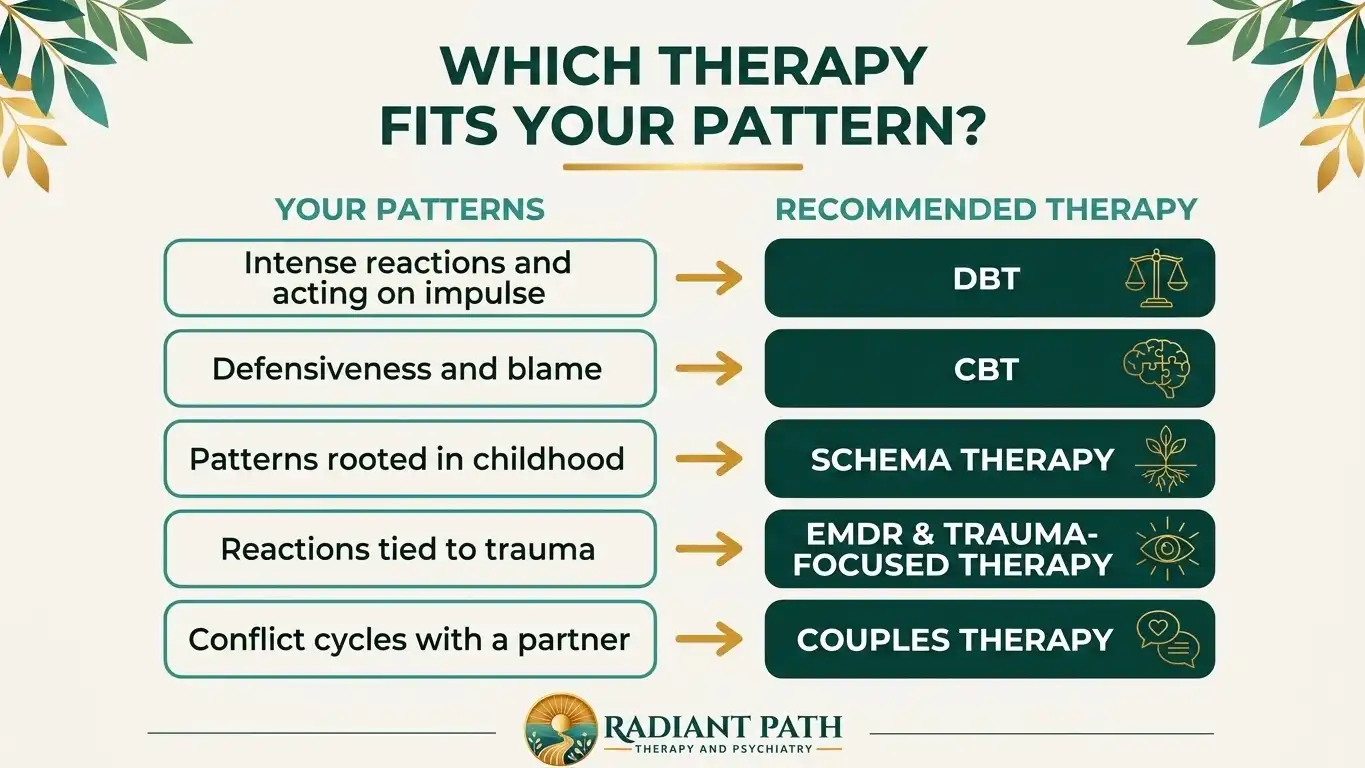
The best fit depends on which pattern causes you the most trouble. Skills-based therapies like DBT and CBT work on what happens in the moment. Schema therapy and trauma-focused therapy work on where the pattern started, and many people use a mix of both. If past therapy felt like talking in circles, skills-based approaches feel different, because each session ends with something specific to practice.
Dialectical Behavior Therapy (DBT) for Intense Emotional Responses
Dialectical behavior therapy (DBT) teaches skills in 4 areas: mindfulness, distress tolerance, emotion regulation, and interpersonal effectiveness. It fits best when overreacting or acting on impulse causes the most damage, because it trains you to spot an emotion early and calm it before you act.
A 2015 trial in JAMA Psychiatry followed 99 women with borderline personality disorder at high risk of suicide. Versions of DBT that included skills training reduced self-harm, depression, and anxiety more than a version without it, which suggests the skills do the real work.
Cognitive Behavioral Therapy (CBT) for Blame and Defensive Thinking
Defensiveness often starts with a fast, automatic thought, such as “They think I’m failing.” Cognitive behavioral therapy teaches you to catch that thought, check the evidence, and respond more calmly. CBT ranked among the therapies that improved emotion regulation in the 2024 review of 18 trials.
CBT focuses on the present. If your emotional responses feel tied to old experiences, CBT may work better alongside schema therapy or trauma-focused work.
Schema Therapy for Patterns That Started in Childhood
Schema therapy looks at deep, long-standing beliefs that formed when childhood needs went unmet, and therapists call these beliefs schemas. One example is a belief that your needs are too much for other people.
The strongest evidence for schema therapy comes from borderline personality disorder. In a 2022 trial with 495 adults, 2 years of combined individual and group schema therapy reduced symptoms more than usual care, which was mostly DBT. Research outside personality disorders is still early, so schema therapy works best for people whose patterns feel deep-rooted and long-standing and who want to understand where they began.
Trauma-Focused Therapy and EMDR for Emotional Responses Rooted in the Past
Some emotional responses come straight from the past. A raised voice at work can make you freeze the way you did as a child. Trauma-focused therapy helps you process those memories so they feel less intense.
Eye movement desensitization and reprocessing (EMDR) is one trauma-focused method. The therapist guides your eye movements while you briefly hold a memory in mind, and you don’t need to describe every detail out loud.
Couples Therapy for Patterns That Show Up in Your Relationship
Sometimes the pattern shows up mostly between you and a partner. One partner pushes for closeness, the other pulls away, and each response feeds the other. Couples therapy works on that cycle with both of you in the room.
In a 2019 meta-analysis of 33 randomized trials, Maren Rathgeber and colleagues found that emotionally focused couples therapy improved relationship satisfaction by a medium amount, about as much as behavioral couples therapy. The gains shrank over the following months, and the authors flag possible publication bias.
Individual Therapy or Group Skills Training
Many DBT programs teach skills in groups alongside one-on-one sessions. A 2021 study in a mixed outpatient group found that each group-based DBT skills module added its own improvement in emotion regulation. The study had no comparison group, so it shows improvement during treatment rather than proof that the groups caused it.
Groups let you practice new skills with other people. One-on-one sessions give you more time on your own history and goals. Ask any practice you’re considering which formats it offers.
How to Choose a Therapist for Emotional Immaturity
Look for a licensed therapist with training in the approach that fits your main pattern, then pay attention to how the first conversation feels. The relationship itself matters.
A 2018 meta-analysis of 295 studies and more than 30,000 patients found that a stronger working relationship between client and therapist predicted better results, both in person and online. The link was modest and doesn’t prove the relationship causes the results, but it held across many types of therapy.
Licenses and Training to Look For
California law requires anyone who provides therapy to hold a state license or registration. That means an LMFT, LCSW, or LPCC license from the Board of Behavioral Sciences, a psychologist license from the Board of Psychology, or a psychiatrist’s medical license. Associates (AMFT, ASW, or APCC) can also provide therapy under a licensed supervisor, and they must tell you they’re supervised. You can check any therapist’s status on the state’s license search.
No law requires a certification in DBT, CBT, schema therapy, or EMDR, so method training is a quality check, not a legal requirement. Ask where and how long the therapist trained in the method that fits your pattern, and whether they still get regular consultation in it.
Questions to Ask in Your First Consultation
Start by asking which approach the therapist would use for the pattern you described, and why. Ask whether they give practice between sessions and how you’ll measure together whether therapy is working. Then find out whether they offer group skills training, couples sessions, or both, and how they check for other causes like ADHD or trauma.
Signs a Therapist May Not Be the Right Fit
The relationship with your therapist shapes your progress, so switching to a better fit isn’t a failure. Consider a change if you notice these signs:
- You leave most sessions feeling judged or labeled.
- After your first month, you still can’t say what you’re working on.
- Your therapist brushes off questions about the approach or your progress.
Is Emotional Immaturity a Diagnosis, and How Do Clinicians Rule Out Other Causes?
No. Emotional immaturity isn’t a diagnosis in the DSM-5-TR. It describes a pattern, and a clinician’s job is to check whether a condition explains that pattern better.
| What it can look like | What may be underneath | What a clinician asks about |
| Quick frustration and mood swings | ADHD | Lifelong trouble with attention, restlessness, and follow-through |
| Freezing, withdrawing, or sudden intense fear | Trauma or complex PTSD | A history of repeated trauma, flashbacks, and feeling constantly on guard |
| Intense fear of abandonment and unstable relationships | Borderline personality disorder | Long-standing patterns in identity, mood, and relationships |
| Low empathy and a strong need for admiration | Narcissistic personality disorder | Whether these traits show up in nearly every setting |
| Irritability and low patience | Depression or anxiety | Changes in sleep, mood, energy, and anxiety |
Clinicians check for ADHD carefully, because a 2020 meta-analysis of 13 studies and 2,535 people found that adults with ADHD have much more trouble regulating emotions than adults without it. At Radiant Path Therapy and Psychiatry, intake at our Grand Terrace and Redlands clinics, or online, starts with this kind of assessment, and confirmed cases can move into ADHD treatment, and ruling a condition out helps as much as ruling one in.
Can Medication Help Emotional Immaturity?
Not directly, because emotional immaturity isn’t a diagnosis, no medication targets it on its own. Medication can still help when another condition, like ADHD, depression, or anxiety, makes your emotions harder to manage.
Skills still come from practice, so medication and therapy usually play different roles. Talk with your prescriber before you change anything about a medication you already take.
What Happens in Your First Month of Therapy?
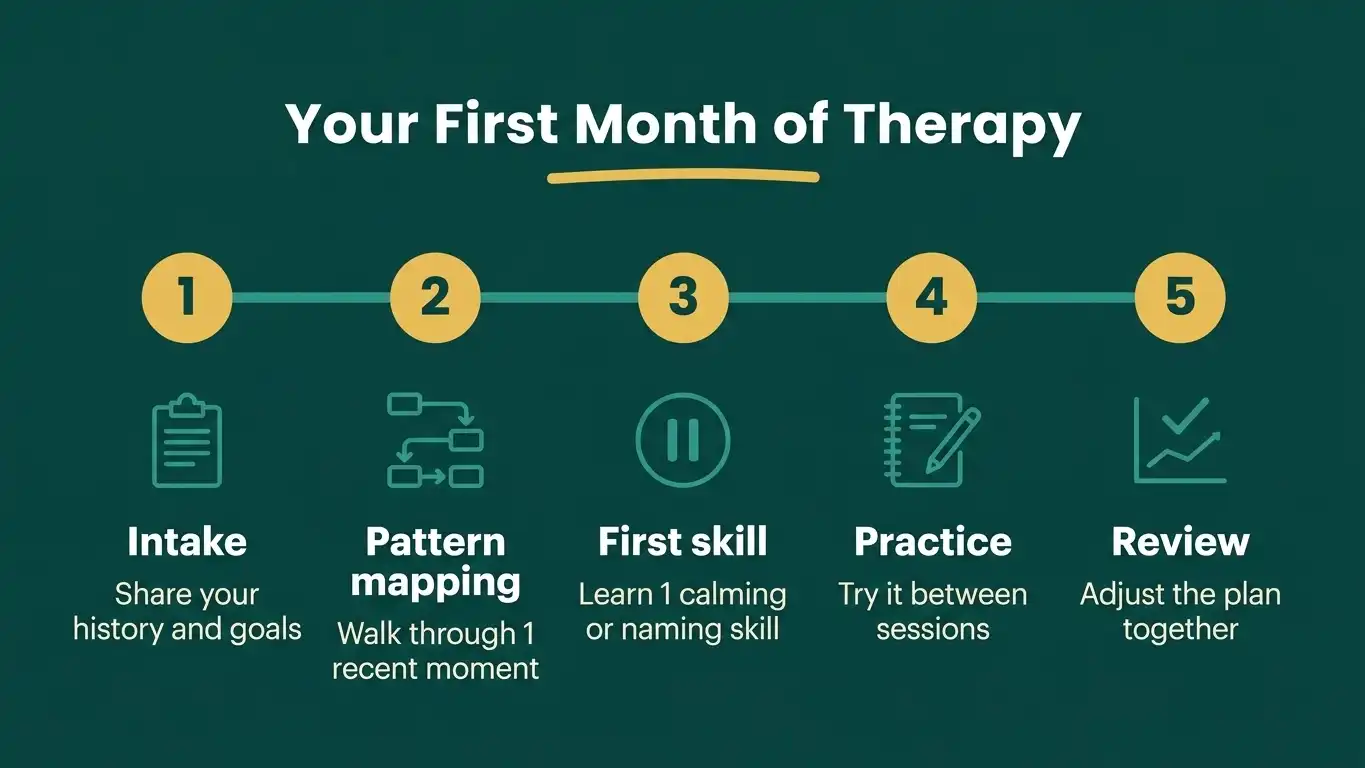
Your first month focuses on understanding your pattern and learning 1 skill to start. Expect weekly or every-other-week sessions of about 45 to 53 minutes.
- Intake: You share your history, what brought you in, and what you want to change.
- Pattern mapping: You and your therapist walk through 1 recent moment step by step, from trigger to response to aftermath.
- First skill: You learn a calming, pausing, or naming skill that fits your pattern.
- Practice: You try the skill between sessions and jot down what happened.
- Review: You and your therapist look at what worked and adjust the plan.
Understanding your pattern gives you a start, but understanding alone rarely changes how you respond. Think of physical therapy after an injury: the first visit explains the injury, and strength comes from the repetitions you do between visits.
What You Practice Between Sessions
Four small practices do most of the work. Name the emotion as it rises with a specific word like frustrated or anxious, and pause before you respond to a difficult message or comment. After a conflict, take responsibility for your part in 1 or 2 sentences, then write down the trigger, your response, and what you would try next time.
Quick tip: When a message upsets you, draft your reply in your notes app first. Reread it 20 minutes later before you send anything.
How Long Does Therapy for Emotional Immaturity Take?
Plan for months, not weeks. A 2021 review of 15 studies and 114,123 patients found that people change at different speeds, and those who start with more severe symptoms usually need longer treatment. Full DBT programs take longer still, and Yale Medicine notes that outpatient DBT runs at least 6 months and often a year or more.
Why so long? You’re replacing responses you’ve practiced for years. New skills need repetition in real moments, and those moments don’t arrive on a schedule.
Signs That Therapy Is Working
Progress often starts quietly. Watch for these signs:
- You notice the emotion building before it peaks.
- You calm down faster after a conflict.
- You apologize or repair sooner, before anyone asks.
- You can hear feedback without building a counterargument.
- People close to you mention the change.
If none of these has started to shift by your third month, raise it with your therapist, because a different approach or format may help.
When Someone Close to You Is Emotionally Immature
You can’t force another adult to change their behavior. You can change how you respond to it, and your own therapy helps with that even if the other person never attends therapy.
If Your Partner Is Emotionally Immature
Ask once, clearly, whether your partner would try couples therapy. Describe the pattern instead of the person: “When we argue, you leave the room, and I feel alone,” not “You’re so immature.” If your partner refuses, or goes but doesn’t engage, individual sessions can help you decide what you’ll accept.
If You Grew Up With Emotionally Immature Parents
You may see a parent’s patterns and, later, notice a few of them in yourself. Therapy can help you identify which responses you learned and which ones you want to keep.
How to Set Boundaries That Protect You
A boundary describes what you will do, not what the other person must do. For example: “If the conversation turns to yelling, I’ll end the call and try again tomorrow.” Then follow through calmly. If anyone’s behavior turns threatening or physical, your safety comes first, and you should call 911 if anyone faces immediate danger.
A 2-Week Plan to Spot Your Pattern and Find the Right Therapy
You don’t need to have everything figured out before you reach out for help. This plan turns what you’ve read into small daily steps, so by the end of 2 weeks you’ll know your main pattern and be ready for a first conversation with a therapist.
| Days | What to do |
| 1 to 3 | Each time 1 of the 5 signs shows up, note the trigger, your response, and how long it took you to calm down. |
| 4 to 7 | Pick your most frequent sign and find the therapy that matches it above. |
| 8 to 10 | Choose 2 questions from the consultation section to ask a therapist. |
| 11 to 14 | Book a consultation, and start 1 between-session practice, such as naming the feeling as it rises. |
You Don’t Have to Work Through Emotional Immaturity Alone
If the same conflicts keep recurring, willpower alone is unlikely to solve them. A therapist can identify your pattern as it happens, match it to the right skills, and help you practice until a calmer response feels natural.
At Radiant Path Therapy and Psychiatry, our licensed therapists use DBT, CBT, and trauma-focused methods, and our psychiatric providers help when another condition needs a closer look. We see clients in Grand Terrace and Redlands and offer secure video sessions across California. Book your confidential 15-minute consultation today, and we will check your insurance benefits before your first visit so you can start with a clear plan.
Conclusion
Emotional immaturity isn’t a diagnosis or a judgment on who you are. It reflects emotion regulation skills that never got enough practice, and therapy builds them by matching your main pattern to the right approach. Most people need a few months of steady practice before the change shows. A symptom points to a system that needs care, not a personal failing, and your emotional responses work the same way.
Frequently Asked Questions
Can I Start Therapy for Emotional Immaturity Online?
Yes. Our team offers individual therapy through secure video sessions anywhere in California. Online sessions use the same approaches as in-person therapy, so you can start from home.
Does Insurance Cover Therapy for Emotional Immaturity?
Coverage depends on your plan and on what your assessment finds. Our team verifies your benefits within 24 hours and explains any costs before your first visit.
What Is the Difference Between Emotional Immaturity and Narcissism?
Narcissistic personality disorder is a diagnosis that involves a lasting need for admiration and low empathy across nearly every setting. Emotional immaturity describes trouble managing emotions, and it can change with practice. A clinician, not an online quiz, can tell the two apart.
Can You Become More Emotionally Mature Without Therapy?
Yes, to some extent. The between-session practices in this guide work on your own. Therapy adds outside feedback, which helps most when the same pattern keeps returning despite your effort.
Do I Need a Diagnosis to Start Therapy?
No. You can start therapy because a pattern is hurting your relationships. Your therapist assesses your concerns during your first sessions.
What If My Partner Says I Am Emotionally Immature and I Am Not Sure I Agree?
Start with curiosity rather than a verdict. Ask for 1 specific moment your partner means, then compare it with the 5 signs above. A therapist can also give you a neutral view, which usually helps more than arguing over the label.
What Phrases Do Emotionally Immature People Often Use?
Common phrases shift blame or shut down the conversation, such as “You’re overreacting,” “It’s not my fault,” “I was only joking,” or “Why are you bringing this up again?” One phrase alone means little. A pattern of these phrases, especially during conflict, points to trouble with accountability.
What Does Emotional Maturity Look Like?
Emotionally mature adults notice their feelings before acting on them, take responsibility for mistakes, and stay engaged during difficult conversations. They can disagree without attacking and apologize without making excuses. These are the same skills therapy for emotional immaturity builds.
At What Age Do People Reach Emotional Maturity?
No single age applies. The brain keeps developing into the mid-to-late 20s, and the area that helps with planning and self-control matures last. After that, emotional maturity depends on skills and experience, so it can keep growing at any age.
Does Emotional Immaturity Look Different in Men and Women?
The core signs are the same for everyone. Social expectations can shape how those signs appear, such as anger in one person and silent withdrawal in another, but no sign belongs to one gender. A clinician looks at the person’s pattern, not their gender.