
How Long Does Cocaine Last? Effects, High, and Detection Time
How long does cocaine last? It depends on what you mean by "last." The high is short, often just minutes. The comedown can continue for days. Cocaine's breakdown products can stay in the body for days, and in hair for months.
At Radiant Path Therapy in Grand Terrace, CA, we know this question is rarely just about a drug test. Some people are worried about a recent experience. Others are noticing cravings, mood changes, or a pattern of use that is getting harder to control. This guide brings together what researchers and medical institutions have found, so you can see exactly where each fact comes from.
How Long Does a Cocaine High Last by Route of Use?
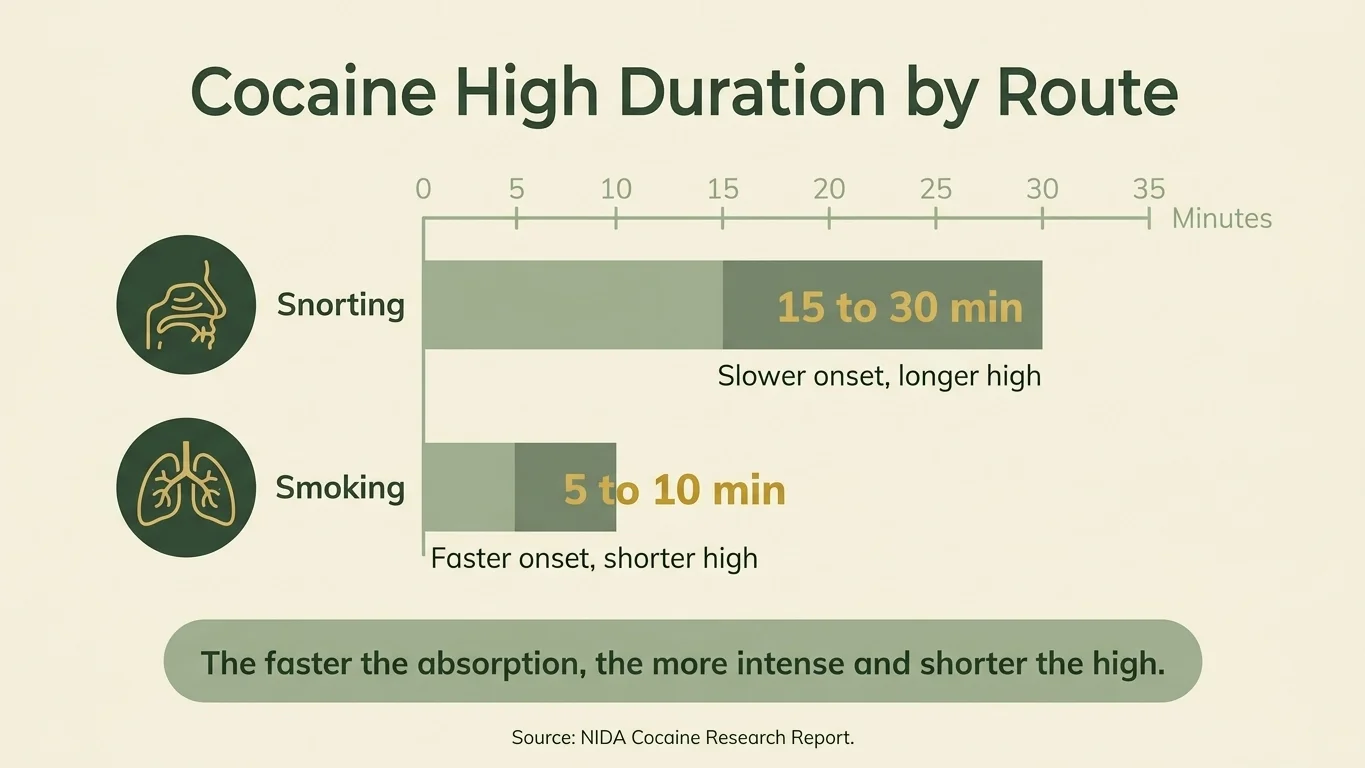
The National Institute on Drug Abuse (NIDA) reports that cocaine's effects begin almost immediately after a single dose and usually fade within a few minutes to an hour. How long the high lasts depends mainly on how the drug enters the body.
According to the NIDA Cocaine Research Report, snorting produces a slower onset, but the high may last about 15 to 30 minutes. Smoking produces a more immediate high that may last only 5 to 10 minutes. NIDA also notes that smoked cocaine enters the bloodstream almost as fast as an injection.
The general rule is that the faster cocaine is absorbed, the more intense and the shorter the high. This short window is one reason people often use cocaine repeatedly in one session, which raises the risk of overdose and dependence.
Because street cocaine is illegal and unregulated, its strength and contents are unpredictable. Any timeline is an estimate, not a guarantee.
What Cocaine Does in the Brain During the High
In The Neurobiology of Cocaine Addiction, published in Science & Practice Perspectives (2005), neuroscientist Eric J. Nestler, MD, PhD explains that whether cocaine is snorted, smoked, or injected, it quickly enters the bloodstream and reaches the brain.
Nestler describes how cocaine blocks the dopamine transporter, the protein that normally clears dopamine away after it is released. With the transporter blocked, dopamine builds up and overstimulates brain cells. This dopamine buildup is what produces the high.
He also explains that repeated use changes brain cells in the limbic system over the intermediate and long term. These changes are lasting enough to help drive the shift from drug use to addiction. This is why cocaine's impact can "last" far longer than the high itself.
Why Cocaine Was Once Used in Medicine
Cocaine was not always only a street drug. In the 1880s, general anesthetics like ether and chloroform made patients vomit, which made delicate eye surgery dangerous. In 1884, doctors discovered that cocaine could numb just the eye, making painless eye surgery possible for the first time.
In a 2011 history of cocaine as an anesthetic, Melody Redman explains that this discovery was crucial to developing modern local anesthetics. Safer drugs like procaine later replaced it. Its risks showed early, though. Surgeon William Halsted, who pioneered cocaine nerve blocks, became addicted within the same year.
Today, NIDA classifies cocaine as a Schedule II drug in the United States. It has a high potential for misuse, but doctors can still use it as a local anesthetic for some eye, ear, and throat procedures.
The Cocaine Comedown: How Long the After-Effects Last
When the high fades, many people go through a comedown, often called a "crash." It can bring tiredness and heavy sleep, low mood, irritability, anxiety, restlessness, trouble concentrating, changes in appetite, and strong cravings for more cocaine. According to a clinical guide from New Spirit Recovery, these acute crash symptoms usually last for the first several days after a binge. Low mood and an inability to feel pleasure, known as anhedonia, can continue for much longer.
The comedown often creates an urge to use again just to feel normal, and over time this cycle can lead to repeated use and dependence. If low mood, anxiety, sleep problems, or cravings continue after stopping, it may be a sign that professional support would help. Recovery is easier with guidance, and treatment can address both the cravings and the emotional strain that often come with cocaine use.
How Long Does Cocaine Stay in Your System?
Feeling normal does not mean cocaine has left your body. The body breaks cocaine down quickly into metabolites, mainly benzoylecgonine and ecgonine methyl ester. Most drug tests look for these metabolites, not cocaine itself.
Mayo Clinic Laboratories data, as summarized by New Spirit Recovery, shows that:
Cocaine's half-life in plasma is roughly 1 hour.
Benzoylecgonine's half-life is roughly 12 hours.
Unchanged cocaine is present in urine for about 1 day after last use.
Benzoylecgonine stays detectable in urine for up to about 4 days at standard cutoffs.
The same source notes that, according to Mayo Clinic Laboratories, the amount measured in a sample does not indicate how impaired someone was. A positive test shows exposure. It does not show dose or current impairment.
Cocaine Detection Times: Urine, Blood, Saliva and Hair
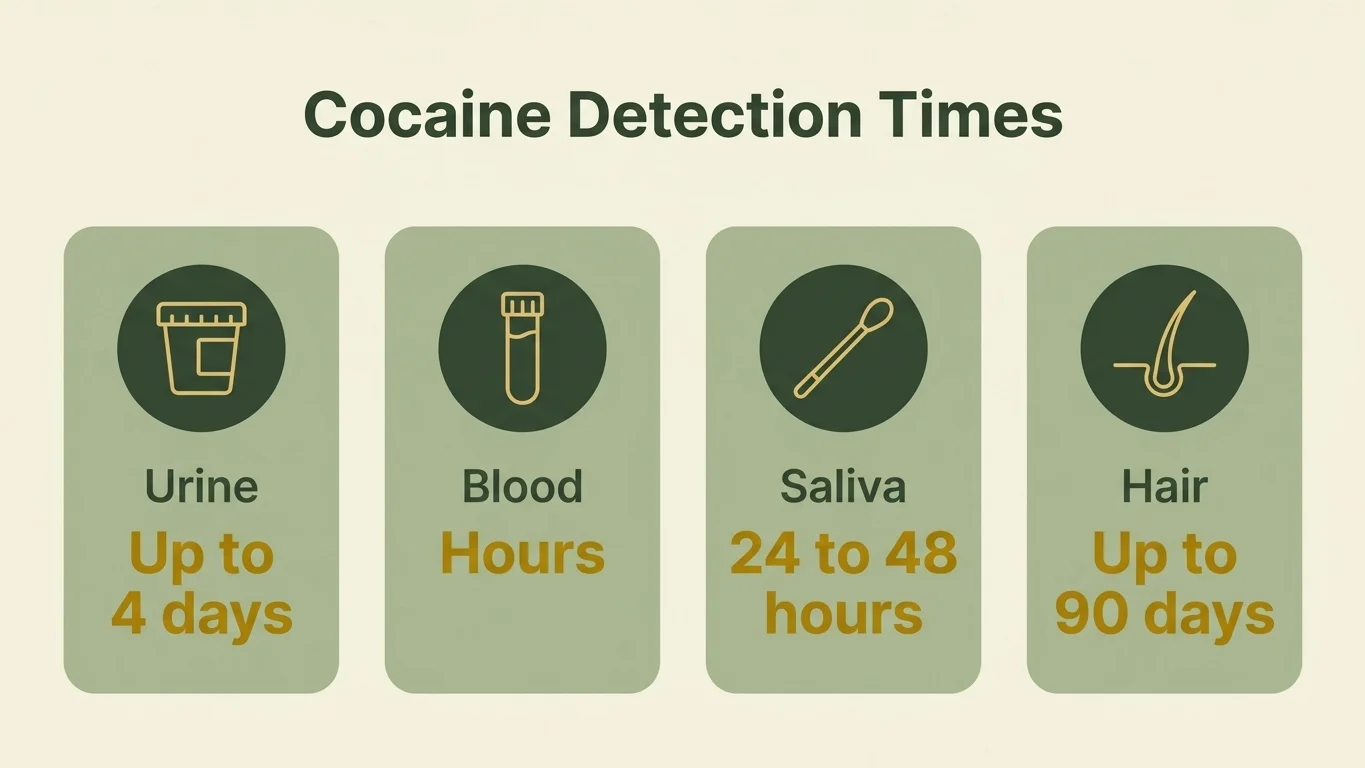
Each type of drug test has a different detection window:
Test type | What it detects | Typical detection window | |
Urine | Benzoylecgonine | Up to about 4 days (standard cutoffs) | |
Blood | Cocaine and metabolites | Hours; the shortest window | |
Saliva (oral fluid) | Cocaine and metabolites | About 24 to 48 hours | |
Hair | Drug built into growing hair | Up to about 90 days |
Urine is the most common test for recent use. Blood is used mainly in emergency, medical, or forensic settings. Saliva suits recent-use testing. Hair shows a pattern of use over months but may miss very recent use, because the drug needs time to grow into the hair.
Why Cocaine Detection Times Differ Between Sources
Published windows disagree mostly because labs use different cutoff levels. Standard urine testing uses a 150 ng/mL screening cutoff and a 100 ng/mL confirmation cutoff for cocaine metabolites.
A 2017 study by Nickley, Pesce, and Krock used a much more sensitive 5 ng/mL test. The researchers found that 51.9% of positive samples fell below the standard cutoff. They also found that the detection window after stopping stretched to 17 to 22 days, compared with about 3 to 4 days at standard cutoffs.
What Affects How Long Cocaine Stays in Your Body?
Several factors change how long cocaine and its metabolites remain detectable:
Amount and frequency of use. Repeated or binge use builds up more metabolites and extends detection.
Individual metabolism. Enzymes in the blood and liver (cholinesterases) break cocaine down at different rates in different people.
Kidney and liver function. The kidneys clear cocaine's metabolites, so reduced kidney function can lengthen the window.
Alcohol and other substances. Drinking changes how cocaine is broken down (see below).
Type of test and cutoff level. Urine, blood, saliva, and hair tests each measure different things over different timeframes.
Cocaine and Alcohol: The Cocaethylene Risk
When cocaine and alcohol are used together, the liver creates a third substance called cocaethylene.
In Cocaethylene: When Cocaine and Alcohol Are Taken Together, published in Cureus (2022), Pergolizzi, Breve, Magnusson, LeQuang and Varrassi describe cocaethylene as more toxic to the heart and liver than cocaine alone.
New Spirit Recovery's summary of the cocaethylene research reports that cocaethylene has a half-life of about 2 hours, roughly twice that of cocaine. This can make intoxication longer and more intense. The same source reports that alcohol was also involved in about 34% of cocaine-related emergency department visits.
Mixing cocaine with alcohol or other drugs does not cancel out the effects. It raises the risk of serious harm.
Health Risks of Cocaine Use
Cocaine affects the heart, brain, and nervous system, and the harm isn't limited to people who use it often. Some risks show up within minutes of a single use, while others build slowly with repeated use. Knowing both can help you recognize when cocaine is starting to affect your health.
Short-Term Risks
Cocaine puts sudden strain on the heart and brain. The NIDA Cocaine Research Report notes that it narrows blood vessels and raises body temperature, heart rate, and blood pressure. It can also cause anxiety, paranoia, irregular heartbeat, seizures, heart attack, or stroke. In rare cases, sudden death can happen even on first use.
Long-Term Risks
Long-term damage depends on how cocaine is used. Snorting can harm the nose and sense of smell, smoking can damage the lungs, and injecting raises the risk of HIV and hepatitis C. Repeated use can also lead to cocaine use disorder. Psychiatrists Roger D. Weiss, Steven M. Mirin, and Roxanne L. Bartel explain in their book Cocaine how this dependence develops and how it is treated.
Hidden Contaminants
Street cocaine is often not what it seems. NIDA warns that cocaine mixed with fentanyl is a major cause of rising overdose deaths, and people usually cannot tell what is in the drug they are taking.
When to Seek Emergency Help After Cocaine Use
Call 911 or go to the nearest emergency room right away if someone has any of the following:
Chest pain or pressure
Severe trouble breathing
Seizures or loss of consciousness
Severe confusion or agitation
Very high body temperature
A very fast or irregular heartbeat
Signs of a stroke, such as sudden weakness, facial droop, or trouble speaking
Do not wait for the effects to wear off. If an opioid overdose is possible and naloxone is available, give it, but still get emergency care.
Signs Cocaine Use Is Becoming a Problem
Nestler's research on cocaine addiction explains why cocaine use can be hard to stop. The brain links the pleasure of cocaine to the people, places, and situations around it. Later, those reminders alone can trigger cravings.
Signs that use may be turning into a disorder include:
Using more often or in larger amounts than intended
Strong cravings, especially in certain places or with certain people
Using to cope with stress, low mood, or emotional pain
Continuing to use despite problems with health, work, or relationships
According to the NIDA Cocaine Research Report, there are currently no FDA-approved medications for cocaine addiction. Behavioral treatments are the main approach. One example is contingency management, which rewards documented abstinence and has shown strong results in helping people stop using and stay in treatment.
Get Support for Cocaine Use at Radiant Path Therapy

You do not have to handle cocaine use alone. Radiant Path Therapy in Grand Terrace, CA provides addiction treatment and support for people dealing with substance use and related mental health concerns.
Treatment can focus on:
Understanding your triggers
Managing cravings
Building coping skills
Creating a healthier daily routine
If you are ready to talk with a professional, reach out to Radiant Path Therapy for an assessment and find out what type of support fits your needs.
Frequently Asked Questions
How long does a cocaine high last?
A snorted cocaine high usually lasts about 15 to 30 minutes, while a smoked high may last only 5 to 10 minutes. The comedown that follows can continue for days.
How long does cocaine stay in your urine?
At standard lab cutoffs, the metabolite benzoylecgonine is usually detectable for up to about 4 days. Heavy or repeated use can extend this, and highly sensitive lab tests have detected it for up to 17 to 22 days.
What is the half-life of cocaine?
Cocaine's half-life in the blood is roughly 1 hour. Its main metabolite, benzoylecgonine, has a half-life of about 12 hours, which is why tests can find it long after the high ends.
Can cocaine be detected after the effects wear off?
The high may last only minutes, but metabolites remain in the body for days. Feeling normal does not mean a drug test will be negative.
How long does cocaine stay in hair?
A standard hair test can show cocaine use over roughly the past 90 days. It may not show very recent use, because the drug takes time to grow into the hair.
Is it more dangerous to mix cocaine and alcohol?
Yes. Using both together creates cocaethylene, a substance that is more toxic to the heart and liver than cocaine alone and can make the effects last longer.


