
Suboxone stays in your system for approximately 5 to 9 days after your last dose, although it may remain detectable on certain drug tests for longer. According to the FDA’s Suboxone prescribing information, buprenorphine, its main active ingredient, has a half-life of 24 to 42 hours. This means most of the medication is eliminated after about five half-lives, but detection times vary depending on the test type, dosage, frequency of use, and individual health factors.
At Radiant Path Therapy and Psychiatry in Grand Terrace, California, we help people understand the difference between how long Suboxone remains in the body and how long drug tests can detect it. Knowing this difference is important because urine, blood, saliva, and hair tests have different detection windows, and a positive test does not necessarily mean the medication is still producing noticeable effects.
How Suboxone Works in the Body
Suboxone works through buprenorphine, which controls cravings and withdrawal, while naloxone is added mainly to stop misuse. Suboxone usually comes as a film or tablet that melts under the tongue. The medicine soaks into your blood through the lining of your mouth. Then your liver breaks it down using a natural enzyme called CYP3A4, which works like a tool the liver uses to process many medicines. The leftover parts leave through stool and urine.
To get the full effect, let the film or tablet dissolve completely under your tongue. Chewing or swallowing it changes how much medicine your body takes in.
Buprenorphine
Buprenorphine is a partial opioid agonist that stays attached to opioid receptors for a long time. In her Ochsner Journal paper, addiction psychiatrist Jennifer R. Velander describes it as long-acting and high-affinity at the mu-opioid receptor. In plain words, it holds on tight and does not let go quickly. That strong grip is why one daily dose can calm cravings all day, and why it lingers in the body.
Naloxone
Naloxone is an opioid blocker that does very little when Suboxone is taken as prescribed. Taken under the tongue, most naloxone is broken down by the liver before it reaches the blood. If someone tries to inject Suboxone, the naloxone can bring on sudden withdrawal, which is why it is included. Because it leaves the body fast, naloxone plays almost no part in how long Suboxone shows up on a test.
How Long Suboxone Stays in Your System After Your Last Dose: Half-Life Explained
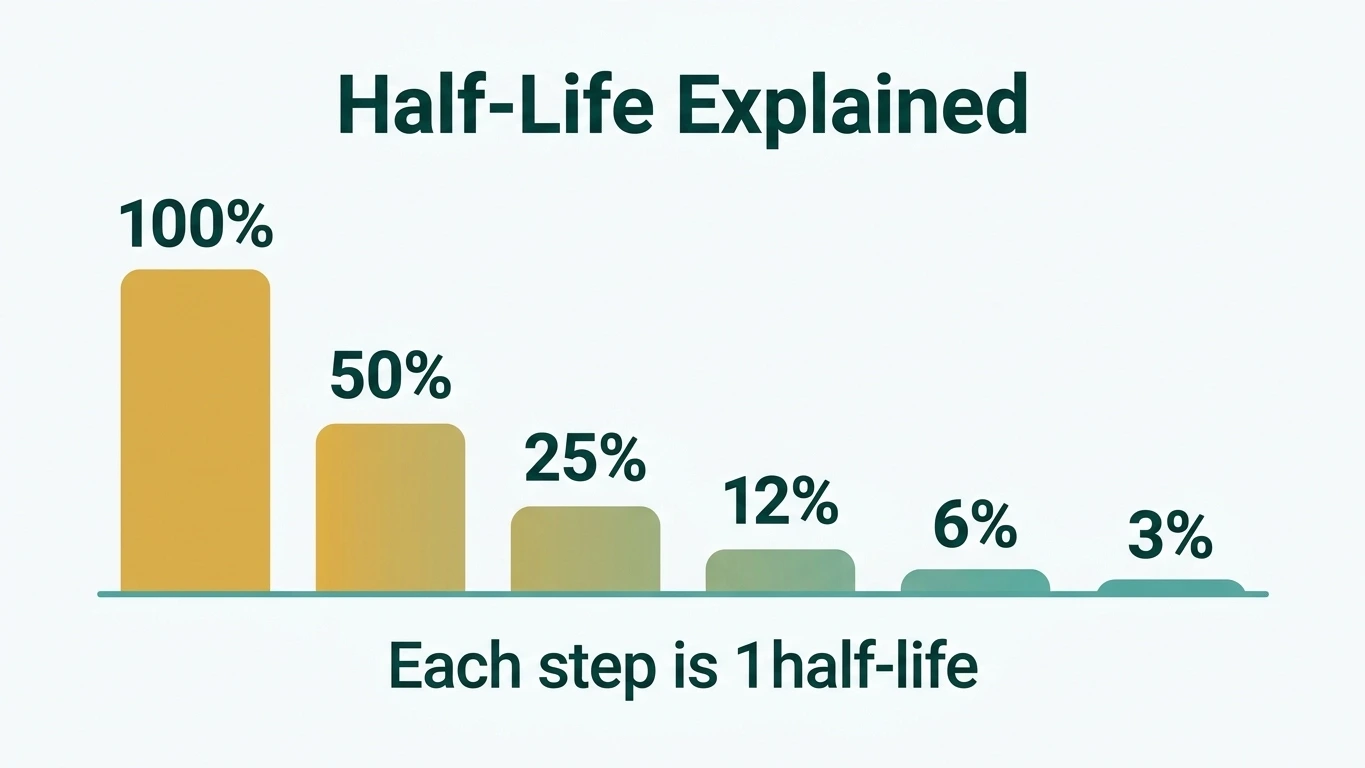
Buprenorphine, the main medicine in Suboxone, takes about 5 to 9 days to leave your body after your last dose. That timing comes from its half-life, which the Suboxone FDA label lists as 24 to 42 hours. Naloxone, the second ingredient, has a much shorter half-life of 2 to 12 hours.
A half-life is the time your body needs to clear half of a drug. After one half-life, half is left. After two, a quarter is left, and so on. Doctors treat a drug as mostly gone after about five half-lives, so you can estimate clearance time by multiplying the half-life by five.
| Ingredient | Half-Life | Time to Clear (5 Half-Lives) | Found on Drug Tests? |
| Buprenorphine | 24 to 42 hours | 5 to 9 days | Yes, with a buprenorphine test |
| Naloxone | 2 to 12 hours | 10 to 60 hours | Not in standard buprenorphine tests |
How Long Can Suboxone Be Detected?
Suboxone can be detected for about 7 to 14 days in urine, 1 to 4 days in blood, 1 to 5 days in saliva, and up to 90 days in hair.
Each test checks a different part of the body, so each has its own window. Labs also use different cutoff levels, which can change a result. Someone who took Suboxone daily for months may test positive longer than someone who took only a few doses. The numbers below are general estimates, not promises.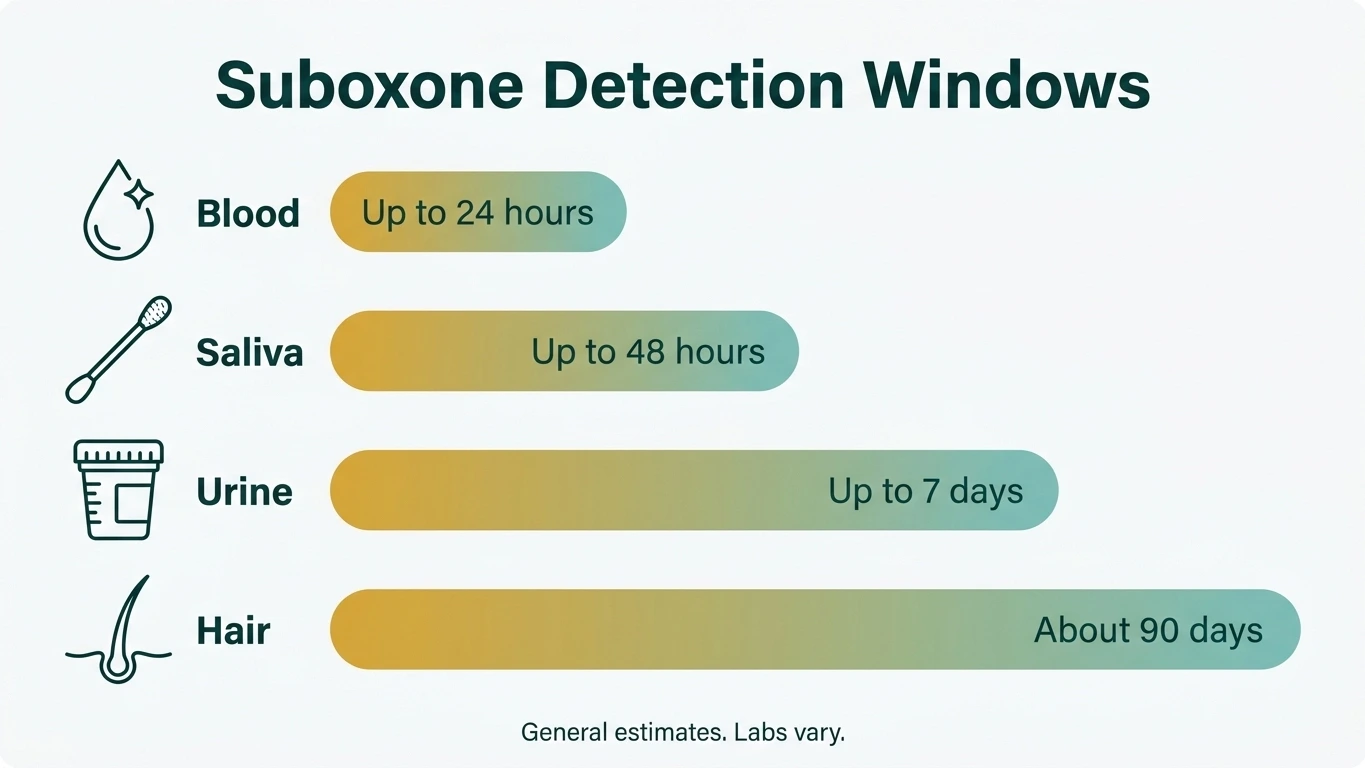
| Test Type | Typical Detection Window | What It Shows |
| Urine | About 7 to 14 days, sometimes longer with long-term use | Most common test; finds buprenorphine and norbuprenorphine |
| Blood | About 1 to 4 days | Recent use; mostly used in hospitals |
| Saliva | About 1 to 5 days | Recent use; quick to collect |
| Hair | Up to about 90 days | A pattern of use over months, not a single recent dose |
If a test result matters for your job, court case, or treatment, ask the lab or your provider exactly which test they use and what it screens for.
How Long Does Suboxone Stay in Urine?
Up to 7 days. Mayo Clinic Laboratories puts the Suboxone detection window for urine at up to 7 days, for both buprenorphine and its byproduct norbuprenorphine. Treatment programs use urine tests to confirm patients are taking their medicine as prescribed. Your dose, how often you take it, and your metabolism decide how long it shows up for you.
How Long Does Suboxone Stay in Blood?
Up to 24 hours. Aegis Sciences reports that blood tests can find buprenorphine for up to 24 hours after the last dose. A blood test shows what is in your system right now, so it fits hospital settings better than routine job or court screening. A positive blood result points to very recent use.
How Long Does Suboxone Stay in Saliva?
Up to 48 hours. Aegis Sciences reports that saliva tests can find buprenorphine for up to 48 hours after the last dose. A mouth swab is quick and easy to collect, so some workplaces use it to check for recent use. Like blood, it shows recent use, not a pattern over weeks or months.
How Long Does Suboxone Stay in Hair?
Several months. Research on hair testing shows it can track buprenorphine use over several months, and a 3 cm hair segment covers about 3 months of growth. Because hair grows slowly, it shows a pattern of use, not a single dose, and it cannot show use in the last few days.
How Long Does Sublocade (Extended-Release BStay in Your System?
Much longer than Suboxone. Sublocade is a monthly injection, so the 5 to 9 day rule does not apply. Aegis Sciences reports that after someone stops Sublocade (extended-release buprenorphine), buprenorphine may stay detectable in plasma and urine for 12 months or longer. Ask your prescriber for documentation before a test and share it with the lab or the medical review officer (MRO).
Does Suboxone Show Up on a Drug Test?
Suboxone only shows up on a drug test if the test looks for buprenorphine, and many standard panels do not.
A basic opiate screen is built to find drugs like morphine, codeine, and heroin. Buprenorphine has a different chemical shape, so it usually does not trigger that screen. To find Suboxone, the lab has to add a separate buprenorphine test. Treatment programs, probation offices, and some employers do add it.
Before any drug test, ask what it screens for. If you have a valid prescription, have your prescription details ready to share.
Can a Standard Drug Test Detect Suboxone?
A standard drug test usually cannot detect Suboxone. Most 5-panel and many 10-panel tests do not include buprenorphine. Expanded panels and treatment-program tests often do. If you have a prescription, share it with the lab or the medical review officer so your result is read correctly.
Can Suboxone Cause a False Positive Drug Test?
Suboxone should not cause a false positive for heroin or fentanyl. It is a different drug and needs its own test. On rare occasions, a screening test may flag buprenorphine because of another medicine. If a result looks wrong, ask for a confirmation test, such as GC-MS or LC-MS, to show what is really there.
Should You Stop Taking Suboxone Before a Drug Test?
Stopping Suboxone suddenly can cause withdrawal, strong cravings, and a return to opioid use. It also will not clear a test quickly, because buprenorphine takes days to leave your body and traces can last longer. After a break, your tolerance drops, and Velander (2018) links renewed use after abstinence to a high overdose risk. Detox drinks, extra water, and exercise do not speed up your liver, and too much water may get the sample flagged as diluted. Instead, talk to your prescriber and share your prescription with the medical review officer (MRO).
What Factors Affect How Long Suboxone Stays in Your System?
Your dose, how long you have taken Suboxone, your metabolism, your liver health, and other medicines all change how long it stays in your system.
Two people can take the same film and clear it at very different speeds. Body size, age, and how often you do all play a part. Some factors, like your genes, are out of your control. Others, like the other medicines you take, can be changed or watched.
Keep an up-to-date list of every medicine and supplement you take, and share it with your provider. This helps them spot anything that could change how your body handles Suboxone.
Dose and Frequency of Use
Higher and more frequent doses can keep Suboxone detectable longer. Mayo Clinic Laboratories notes that detection time depends on your dose, how often you take it, and your metabolism. The form of buprenorphine matters too. Sublocade, the monthly injection, stays detectable far longer than the film or tablet, as explained in the Sublocade section above.
Length of Time Taking Suboxone
The longer you take Suboxone, the longer it can stay in your system. Someone who took it for a few days clears it faster than someone on it for a year. Long-term use lets buprenorphine and norbuprenorphine build up, which can stretch urine and hair test windows.
Metabolism
A faster metabolism clears Suboxone sooner, and a slower one keeps it longer. Age, genes, activity level, and body fat all affect metabolism. Older adults often clear medicines more slowly than younger adults.
Liver Function
Poor liver function can keep Suboxone in your system longer. The liver does most of the work of breaking down buprenorphine. Hepatitis, cirrhosis, or heavy drinking can slow it down. If you have liver problems, your doctor may need to adjust your dose.
Other Medications and Health Factors
Some medicines make Suboxone last longer, and others make it clear faster. Certain antifungals, antibiotics, and HIV drugs slow the CYP3A4 enzyme. Some seizure medicines and rifampin speed it up. Mixing Suboxone with alcohol or benzodiazepines can be dangerous, so always tell your provider everything you take.
Can You Speed Up the Elimination of Suboxone?
No, there is no safe or proven way to speed up how fast Suboxone leaves your body. Detox drinks and online tricks do not change how quickly your liver breaks down buprenorphine. Drinking lots of water may thin your urine, but labs check for that and may mark the sample as diluted or invalid. Exercise and sweating will not clear a long-acting drug in a few hours either.
Trying to rush the process can also be risky. Stopping Suboxone suddenly to pass a test can bring on withdrawal, cravings, and a return to opioid use. After a break, your tolerance drops, which raises the risk of overdose. If you are worried about an upcoming test, talk to your prescriber before you change anything.
Can Suboxone Still Affect You After It Is No Longer Detectable?
Yes, your body can still feel the effects of stopping Suboxone even after tests no longer find it. A drug test only looks for chemicals. It does not measure how you feel or how well your cravings are controlled. A test may still find norbuprenorphine after the medicine has stopped easing cravings.
At the same time, your brain keeps adjusting even after Suboxone is fully gone. Poor sleep, low mood, and cravings can last for weeks. A negative test does not mean your recovery needs are over. Keep up with therapy, support groups, or check-ins with your care team during this time.
How Long Does Suboxone Withdrawal Last After Stopping?
Suboxone withdrawal often starts 1 to 3 days after the last dose and peaks around days 3 to 5. The physical symptoms usually ease within 1 to 2 weeks, but some symptoms can last longer.
Because buprenorphine leaves slowly, withdrawal tends to start later and feel milder than withdrawal from heroin or fentanyl. Common symptoms include body aches, sweating, a runny nose, stomach upset, trouble sleeping, anxiety, and strong cravings. How long it lasts depends on your dose, how long you took it, and whether you tapered slowly. Some people deal with low energy, poor sleep, and mood changes for weeks or months.
Pressure to stop often comes from stigma, not medical need. In a 2022 study in Substance Abuse: Research and Treatment, Julia Dickson-Gomez and her team found that many treatment providers saw medications for opioid use disorder (MOUD) as a temporary tool, which led to patients being tapered off after some time. If you are thinking about stopping, make a plan with your healthcare provider. A slow taper is usually easier on your body than stopping all at once.
Why Does Suboxone Treatment Duration Matter?
Longer treatment is linked to a lower risk of overdose. Suboxone is one of the medications for opioid use disorder (MOUD), which are FDA-approved medicines, such as buprenorphine and methadone, that treat opioid use disorder. A 2024 Harm Reduction Journal study by Dickson-Gomez and colleagues notes that stopping these medications carries a higher overdose risk. At our addiction treatment center, we help you decide how long treatment should last with your prescriber.
When Should You Talk With a Healthcare Professional?

You should talk with a healthcare professional any time you plan to change your Suboxone, have trouble with symptoms, or have concerns about testing or relapse.
Your care team can catch problems early and help you avoid risky choices. Reach out to your prescriber if any of these apply to you:
- You are thinking about stopping or lowering your Suboxone dose.
- You have withdrawal symptoms that feel hard to manage.
- You have a drug test coming up and are unsure how your prescription will show.
- You started a new medicine or supplement, or you have liver concerns.
- You notice stronger cravings or worry about going back to opioid use.
If you or someone near you shows signs of an overdose, such as slow breathing or not waking up, call 911 right away.
Conclusion
Buprenorphine usually clears from your body in about 5 to 9 days after your last dose, but a drug test can find it for a different length of time, because each type of test has its own window. Blood tests find it for up to 24 hours, saliva tests for up to 48 hours, urine tests for up to 7 days, and hair tests for several months.
If you are trying to work out how long Suboxone stays in your system before a test, first find out which test you will take. Your dose and liver health will move your own timeline too. A positive result does not mean the medicine is still working. Stopping Suboxone just to pass a test can bring on withdrawal and raise your overdose risk, so talk with your prescriber first.
Get Support at Radiant Path Therapy in Grand Terrace, CA
Have questions about Suboxone, drug tests, or what comes next in your recovery? You do not have to sort it out alone. Radiant Path Therapy and Psychiatry in Grand Terrace, California offers addiction treatment, dual diagnosis care, and intensive outpatient programs for adults across the Inland Empire, both in person and through telehealth. Our licensed team works with you to build a plan that fits your health, your goals, and your life.
Same-day appointments are often available, and we verify PPO insurance benefits at no cost. Call us at (909) 577-1124 or contact us online to take your next step today.
Frequently Asked Questions
How long does Suboxone stay in urine?
Suboxone usually stays in urine for about 7 to 14 days after the last dose. Urine tests look for both buprenorphine and its byproduct, norbuprenorphine, which is why the window is fairly long. People who took Suboxone daily for many months may test positive for a little longer.
How long does Suboxone stay in your hair?
Suboxone can stay in hair for up to about 90 days. A hair test shows a pattern of use over several months, not a single recent dose. Because hair needs time to grow, it also cannot show whether someone took Suboxone in the last few days.
Does Suboxone show up on a standard drug test?
No, Suboxone usually does not show up on a standard drug test. Basic opiate screens look for drugs like morphine, codeine, and heroin, and buprenorphine has a different chemical shape. It only shows up if the lab adds a separate buprenorphine test, which treatment programs and probation offices often do.
How long after stopping Suboxone does it leave your body?
Most buprenorphine leaves your body in about 5 to 9 days after stopping. This is based on its 24 to 42 hour half-life, since a drug is mostly cleared after about five half-lives. Small byproducts can still show up on some tests for a while after that, especially in urine and hair.
Does drinking water help get Suboxone out of your system?
No, drinking water does not help Suboxone leave your system faster. Your liver breaks down buprenorphine at its own pace, and extra water does not change that. Drinking too much before a test may only dilute your urine sample, and labs can flag it as invalid.
How long does Suboxone stay in your system after 1 dose?
About 5 to 9 days for the buprenorphine in a single film, based on its 24 to 42 hour half-life on the FDA label. A urine test may find it for up to 7 days (Mayo Clinic Laboratories).