
What Is Individual Psychotherapy and How Does It Work?

Life can become difficult when stress, anxiety, sadness, trauma, or personal problems start to affect your daily life. Individual psychotherapy gives you one-on-one time with a trained mental health professional to understand what you are going through, learn healthier ways to cope, and work toward changes that matter to you. At Radiant Path Therapy and Psychiatry in Grand Terrace, CA, adults can receive trauma-specialized, evidence-based therapy in person or through secure telehealth therapy. Every treatment plan is built around your goals. Understanding Individual Psychotherapy Individual psychotherapy is a mental health treatment in which one person works directly with a trained therapist on their thoughts, feelings, behaviors, relationships, and life experiences. The meaning of psychotherapy goes beyond simply talking about problems. According to the National Institute of Mental Health’s overview of psychotherapy, psychotherapy, also called talk therapy, covers a range of treatments that help people identify and change troubling emotions, thoughts, and behaviors, and most of it takes place one-on-one with a licensed mental health professional. NIMH lists its main goals as relieving symptoms, maintaining or improving daily functioning, and improving quality of life. What Is Individual Therapy? Individual therapy is the everyday name for the same one-on-one treatment. Some practices also list it as individual counseling psychotherapy. The terms are often used interchangeably, although the exact services depend on the therapist’s training, license, and approach. Why the One-on-One Format Matters In psychotherapy, individual sessions give you the therapist’s full attention. Couples, family, and group formats divide the focus among several people. One-on-one work gives you space to explore your own experiences, including things that feel hard to say in front of others. Individual Psychotherapy vs. Other Therapy Formats In psychotherapy, individual sessions give you the therapist’s full attention, while other formats divide the focus among several people. Format Who Is Involved What It Focuses On Individual psychotherapy You and a therapist Your thoughts, feelings, behaviors, trauma, and personal goals Couples therapy Two partners and a therapist Communication, trust, conflict, and connection Family therapy Family members and a therapist Family conflict and patterns that affect everyone Group therapy Several people and a therapist A shared concern, peer support, and coping skills Individual therapy is often the best fit when you want to focus on your own experiences or discuss things that feel hard to say in front of others. How Does Individual Psychotherapy Work? Therapy can look different from one approach to another, but many approaches share a similar structure. In The Structure of Individual Psychotherapy (1990), psychiatrist Bernard D. Beitman describes four stages: engagement, pattern search, change, and termination. Stage 1: Engagement and Building Trust In the first few sessions, your therapist learns about your history, concerns, and goals. Together, you decide how to work toward the changes you want. This relationship has a real effect on results. A 2011 research synthesis by Horvath and colleagues reviewed more than 14,000 treatments and found that a stronger client-therapist bond was linked to better outcomes across different types of therapy. The American Psychological Association also highlights this relationship as key to how therapy works. Trust often takes a few sessions to develop, and that is normal. Stage 2: Pattern Search Next, you and your therapist look for the patterns behind your concerns. These are the links between your thoughts, feelings, and behaviors. For example, avoiding a stressful situation may bring short-term relief but make anxiety stronger over time. Stage 3: Change Once a pattern is clear, you begin practicing new ways to respond. Therapists choose methods based on their training, your concerns, and your goals. The National Institute of Mental Health explains that psychotherapy can include different treatment approaches, and that treatment may be tailored to the condition being treated and the needs of the person receiving care. Stage 4: Ending Therapy When you have met your goals, you and your therapist plan how to finish treatment. This includes reviewing your progress and preparing you to keep using your skills on your own. Who Can Benefit From Individual Psychotherapy? You do not need a diagnosis, and you do not need to wait until things feel severe. NIMH notes that people seek therapy for reasons such as long-term stress, the loss of a loved one, relationship problems, and unexplained changes in sleep, appetite, energy, or mood. Anxiety and Stress Therapy can help when worry, fear, or panic starts to interfere with daily life. NIMH notes that CBT is commonly used for generalized anxiety disorder and can help people understand automatic thoughts and change patterns that contribute to anxiety. Learn more about our anxiety treatment. Depression and Mood Concerns Depression can affect your mood, energy, sleep, and motivation. NIMH explains that psychotherapy is one common treatment for depression, and approaches such as CBT and interpersonal therapy may be used. See our depression treatment services. Trauma and Painful Experiences Abuse, accidents, violence, and sudden loss can affect your sleep, relationships, and sense of safety. A trauma-informed therapist helps you work through these experiences at a manageable pace, starting with safety and stability. Radiant Path Therapy and Psychiatry also offers specialized care for PTSD and complex trauma. Therapy for Mental Illness As therapy for mental illness, psychotherapy is used for anxiety disorders, depression, trauma-related conditions, and other diagnosed concerns. According to NIMH, it can be used instead of or alongside medication, and the right plan depends on each person’s needs under the guidance of a mental health professional. When mental health and substance use overlap, dual diagnosis treatment addresses both together. Types of Therapy Used in Individual Psychotherapy Each approach has its own focus. Many therapists combine techniques from more than one. Cognitive Behavioral Therapy (CBT) CBT helps you notice automatic thoughts that are inaccurate or harmful, question them, and change self-defeating behavior patterns. It is one of the most widely studied approaches for anxiety and depression. EMDR and Somatic Therapy for Trauma EMDR (Eye Movement Desensitization and Reprocessing) uses guided eye movements to help the brain reprocess memories that feel stuck. You do not need
How Long Does Cocaine Last? Effects, High, and Detection Time
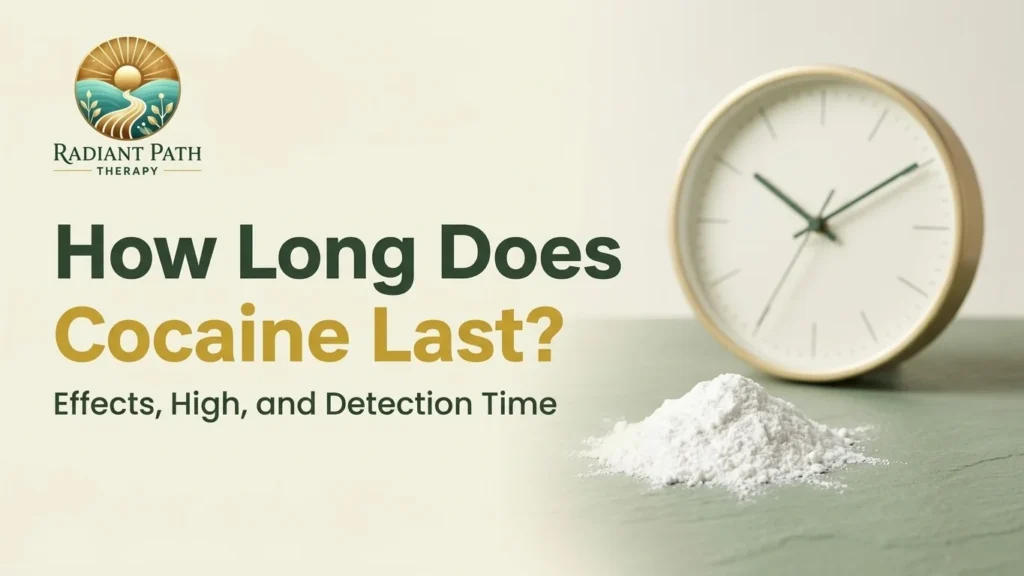
How long does cocaine last? It depends on what you mean by “last.” The high is short, often just minutes. The comedown can continue for days. Cocaine’s breakdown products can stay in the body for days, and in hair for months. At Radiant Path Therapy and Psychiatry in Grand Terrace, CA, we know this question is rarely just about a drug test. Some people are worried about a recent experience. Others are noticing cravings, mood changes, or a pattern of use that is getting harder to control. This guide brings together what researchers and medical institutions have found, so you can see exactly where each fact comes from. How Long Does a Cocaine High Last by Route of Use? The National Institute on Drug Abuse (NIDA) reports that cocaine’s effects begin almost immediately after a single dose and usually fade within a few minutes to an hour. How long the high lasts depends mainly on how the drug enters the body. According to the NIDA Cocaine Research Report, snorting produces a slower onset, but the high may last about 15 to 30 minutes. Smoking produces a more immediate high that may last only 5 to 10 minutes. NIDA also notes that smoked cocaine enters the bloodstream almost as fast as an injection. The general rule is that the faster cocaine is absorbed, the more intense and the shorter the high. This short window is one reason people often use cocaine repeatedly in one session, which raises the risk of overdose and dependence. Because street cocaine is illegal and unregulated, its strength and contents are unpredictable. Any timeline is an estimate, not a guarantee. What Cocaine Does in the Brain During the High In The Neurobiology of Cocaine Addiction, published in Science & Practice Perspectives (2005), neuroscientist Eric J. Nestler, MD, PhD explains that whether cocaine is snorted, smoked, or injected, it quickly enters the bloodstream and reaches the brain. Nestler describes how cocaine blocks the dopamine transporter, the protein that normally clears dopamine away after it is released. With the transporter blocked, dopamine builds up and overstimulates brain cells. This dopamine buildup is what produces the high. He also explains that repeated use changes brain cells in the limbic system over the intermediate and long term. These changes are lasting enough to help drive the shift from drug use to addiction. This is why cocaine’s impact can “last” far longer than the high itself. Why Cocaine Was Once Used in Medicine Cocaine was not always only a street drug. In the 1880s, general anesthetics like ether and chloroform made patients vomit, which made delicate eye surgery dangerous. In 1884, doctors discovered that cocaine could numb just the eye, making painless eye surgery possible for the first time. In a 2011 history of cocaine as an anesthetic, Melody Redman explains that this discovery was crucial to developing modern local anesthetics. Safer drugs like procaine later replaced it. Its risks showed early, though. Surgeon William Halsted, who pioneered cocaine nerve blocks, became addicted within the same year. Today, NIDA classifies cocaine as a Schedule II drug in the United States. It has a high potential for misuse, but doctors can still use it as a local anesthetic for some eye, ear, and throat procedures. The Cocaine Comedown: How Long the After-Effects Last When the high fades, many people go through a comedown, often called a “crash.” It can bring tiredness and heavy sleep, low mood, irritability, anxiety, restlessness, trouble concentrating, changes in appetite, and strong cravings for more cocaine. According to a clinical guide from New Spirit Recovery, these acute crash symptoms usually last for the first several days after a binge. Low mood and an inability to feel pleasure, known as anhedonia, can continue for much longer. The comedown often creates an urge to use again just to feel normal, and over time this cycle can lead to repeated use and dependence. If low mood, anxiety, sleep problems, or cravings continue after stopping, it may be a sign that professional support would help. Recovery is easier with guidance, and treatment can address both the cravings and the emotional strain that often come with cocaine use. How Long Does Cocaine Stay in Your System? Feeling normal does not mean cocaine has left your body. The body breaks cocaine down quickly into metabolites, mainly benzoylecgonine and ecgonine methyl ester. Most drug tests look for these metabolites, not cocaine itself. Mayo Clinic Laboratories data, as summarized by New Spirit Recovery, shows that: Cocaine’s half-life in plasma is roughly 1 hour. Benzoylecgonine’s half-life is roughly 12 hours. Unchanged cocaine is present in urine for about 1 day after last use. Benzoylecgonine stays detectable in urine for up to about 4 days at standard cutoffs. The same source notes that, according to Mayo Clinic Laboratories, the amount measured in a sample does not indicate how impaired someone was. A positive test shows exposure. It does not show dose or current impairment. Cocaine Detection Times: Urine, Blood, Saliva and Hair Each type of drug test has a different detection window: Test type What it detects Typical detection window Urine Benzoylecgonine Up to about 4 days (standard cutoffs) Blood Cocaine and metabolites Hours; the shortest window Saliva (oral fluid) Cocaine and metabolites About 24 to 48 hours Hair Drug built into growing hair Up to about 90 days Urine is the most common test for recent use. Blood is used mainly in emergency, medical, or forensic settings. Saliva suits recent-use testing. Hair shows a pattern of use over months but may miss very recent use, because the drug needs time to grow into the hair. Why Cocaine Detection Times Differ Between Sources Published windows disagree mostly because labs use different cutoff levels. Standard urine testing uses a 150 ng/mL screening cutoff and a 100 ng/mL confirmation cutoff for cocaine metabolites. A 2017 study by Nickley, Pesce, and Krock used a much more sensitive 5 ng/mL test. The researchers found that 51.9% of positive samples fell below the
Combined Drug Intoxication: Risks, Signs, and Treatment
Combined drug intoxication happens when 2 substances react together, raising overdose risk. Radiant Path Therapy and Psychiatry offers same-day care in Grand Terrace, CA.
Can Therapists Diagnose Mental Health Conditions?

Licensed therapists can diagnose over 4 common mental health conditions through clinical assessment. See how Radiant Path Therapy and Psychiatry can help you today.
Cognitive Behavioral Therapy for Dissociative Disorder: How It Can Help
Learn how cognitive behavioral therapy for dissociative disorder may help with symptoms, coping, and stability at Radiant Path Therapy and Psychiatry, Grand Terrace, CA.
Separation Anxiety in Adults: Symptoms, Causes, and Treatment

Separation anxiety in adults is treatable. Learn proven signs, CBT treatments. Contact Radiant Path Therapy and Psychiatry in Grand Terrace to start healing today.
Signs Your Body Is Releasing Trauma: What Healing Can Feel Like

The 7 signs your body is releasing trauma include trembling, deep breaths, and fatigue. Learn more from our licensed somatic therapists. Book today.
EMDR Phases: A Complete Guide to How EMDR Therapy Works
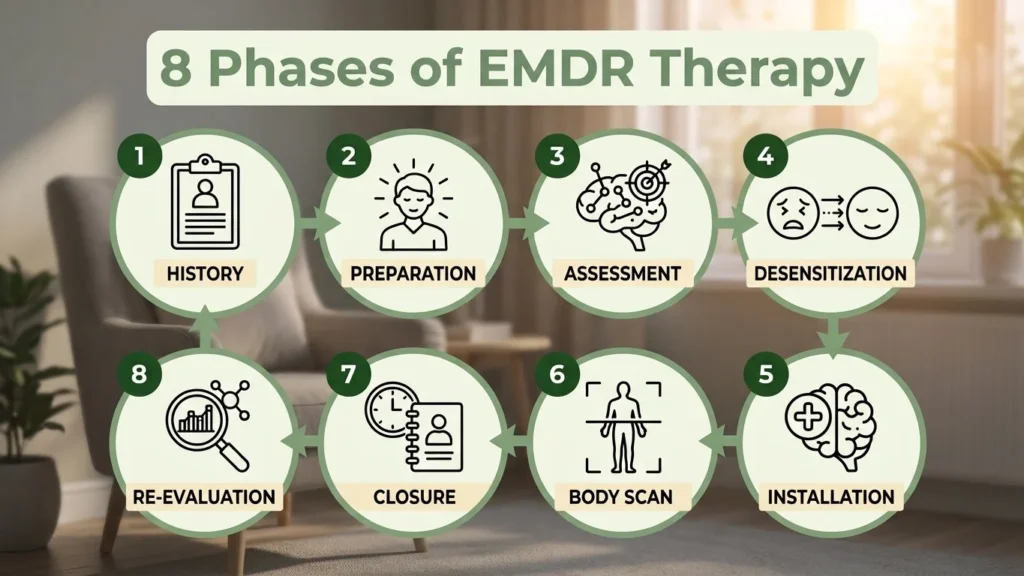
EMDR phases follow a clear 8-step framework, from preparation to reevaluation. Discover what to expect, then find a trauma therapist near you.
How Long Does It Take to Recover From Depression? A Complete Guide
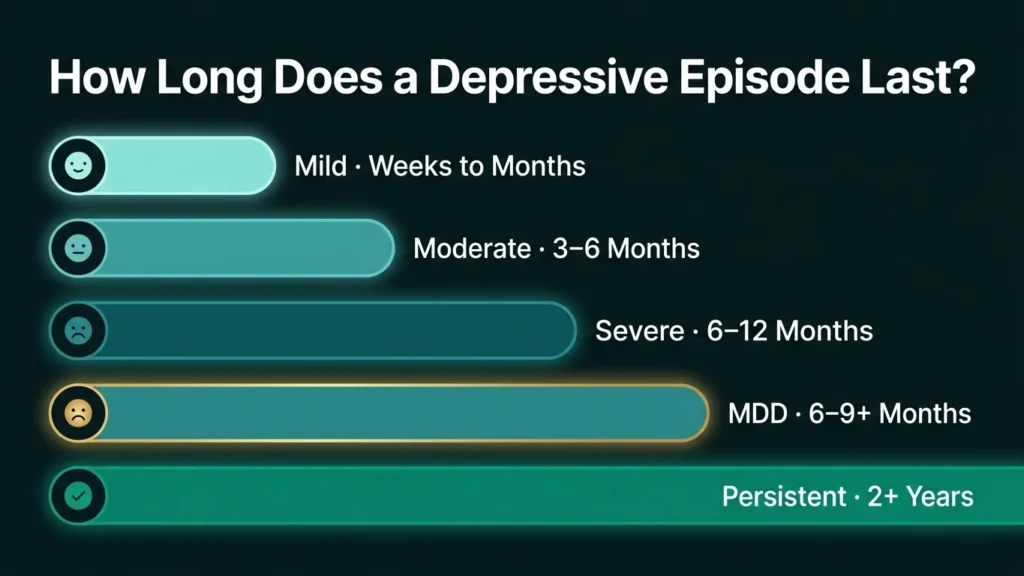
Major depressive disorder can last years untreated. See how treatment changes your depression recovery timeline, and what speeds it up.
Heal Childhood Trauma Without Therapy: 9 Real Steps

Heal childhood trauma without therapy using self-help steps, then contact Radiant Path Therapy and Psychiatry in Grand Terrace, CA to book a consultation today.